
OpenAI has officially introduced GPT-5.6, a new generation of artificial intelligence models designed to deliver smarter responses, handle more complex tasks, and reduce costs for businesses and developers.
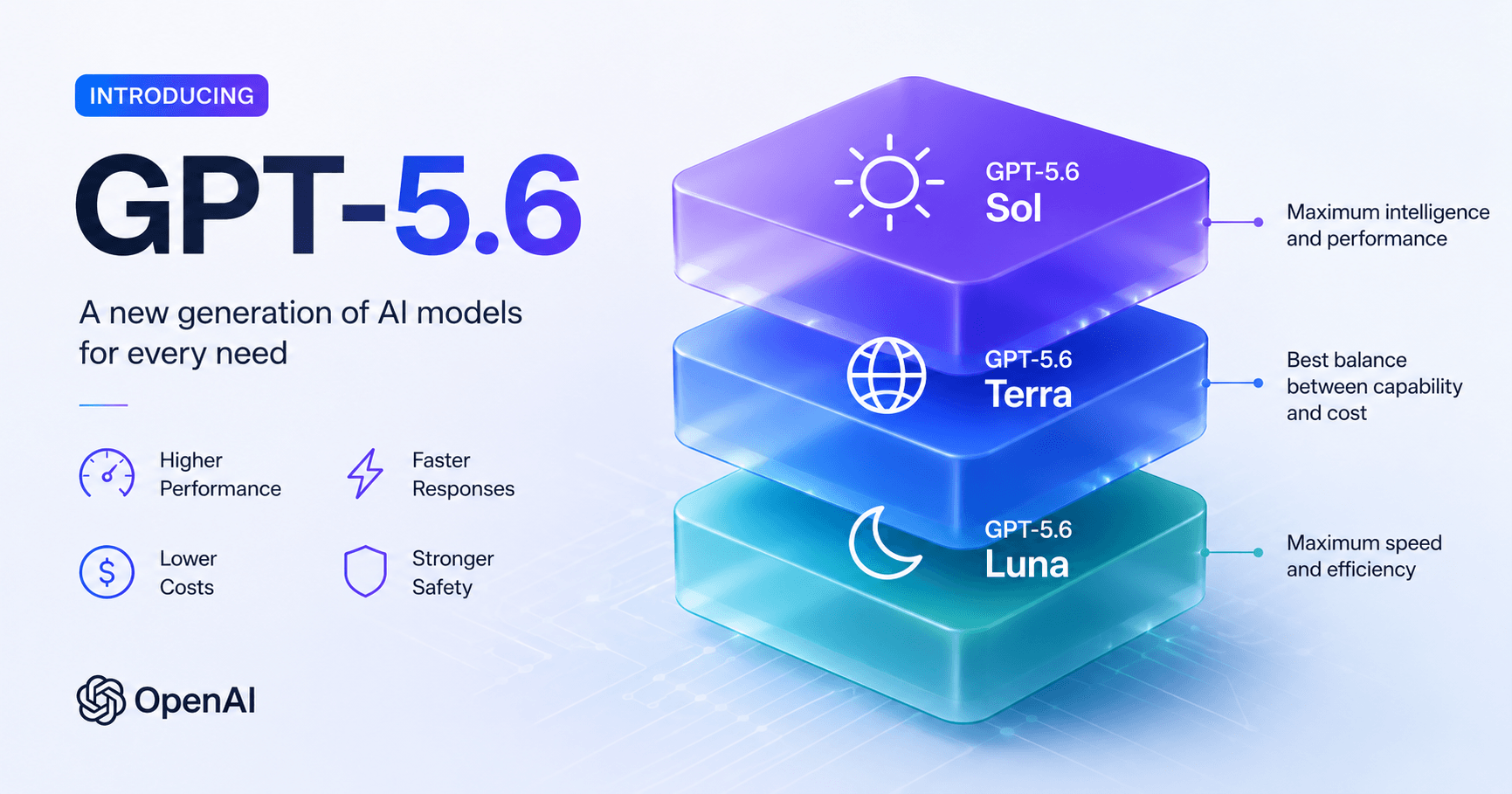
Unlike previous releases, GPT-5.6 is not a single model. The new family includes three versions: Sol, Terra, and Luna, each built for different performance, speed, and cost requirements.
This marks a new chapter in artificial intelligence, giving developers and organizations greater flexibility when building applications, automating workflows, or integrating AI into everyday tasks.
A Family of Models for Different Needs
OpenAI has organized GPT-5.6 into three distinct tiers.
GPT-5.6 Sol is the most powerful model in the lineup. It is designed for advanced reasoning, software development, scientific research, large-scale data analysis, and professional workflows that require the highest level of intelligence.
GPT-5.6 Terra provides the best balance between performance and cost. According to OpenAI, it delivers capabilities comparable to GPT-5.5 while operating at roughly half the cost, making it an excellent choice for enterprise applications.
GPT-5.6 Luna focuses on speed and efficiency. It is optimized for chatbots, customer support, content classification, and large-scale applications that process thousands of requests with minimal latency.
Higher Performance at a Lower Cost
One of the biggest goals behind GPT-5.6 is improving efficiency.
Instead of simply increasing model size, OpenAI focused on making the models produce higher-quality responses while using fewer tokens.
In practice, this means:
Faster responses
Lower processing costs
Higher productivity
Better performance on long and complex tasks
These improvements benefit both end users and companies building AI-powered products with the OpenAI API.
Improved for Coding and Professional Work
GPT-5.6 brings significant upgrades for technical and professional use cases.
Some of the major improvements include:
More reliable code generation
Better debugging and error detection
Improved understanding of large software projects
Stronger support for technical research
Higher-quality professional document creation
Better performance on advanced analytical tasks
OpenAI also highlights major improvements in computer use, workflow automation, and software engineering capabilities.
Enhanced Safety
Performance isn't the only area that received attention.
Before launch, GPT-5.6 underwent extensive internal testing, including automated red-teaming processes designed to identify vulnerabilities and reduce risks associated with sensitive requests.
The goal is to provide a more robust and trustworthy model while maintaining its ability to solve real-world problems.
A New Way to Organize AI Models
Another major change is the naming system.
The version number now represents the technology generation, while the names Sol, Terra, and Luna indicate different capability levels.
This makes it easier for developers and businesses to choose the right model for each application:
Sol: Maximum intelligence and performance
Terra: The best balance between capability and cost
Luna: Maximum speed and efficiency
What Does This Mean for Developers and Businesses?
For developers building AI-powered products, GPT-5.6 represents an important step forward.
The combination of stronger performance, lower operating costs, and multiple capability tiers makes it possible to build more efficient applications while keeping infrastructure expenses under control.
The new generation is also designed with AI agents, workflow automation, software engineering, and increasingly complex business processes in mind.
Final Thoughts
GPT-5.6 is more than just another model update. It introduces a new approach to artificial intelligence by offering specialized models tailored to different performance and cost requirements.
With significant improvements in reasoning, software development, automation, research, and safety, the GPT-5.6 family demonstrates where AI is heading: more efficient, more specialized, and increasingly capable of acting as a true digital collaborator.
Read more: https://openai.com/index/gpt-5-6/


Комментарии0
Пожалуйста, войдите, чтобы оставить комментарий.