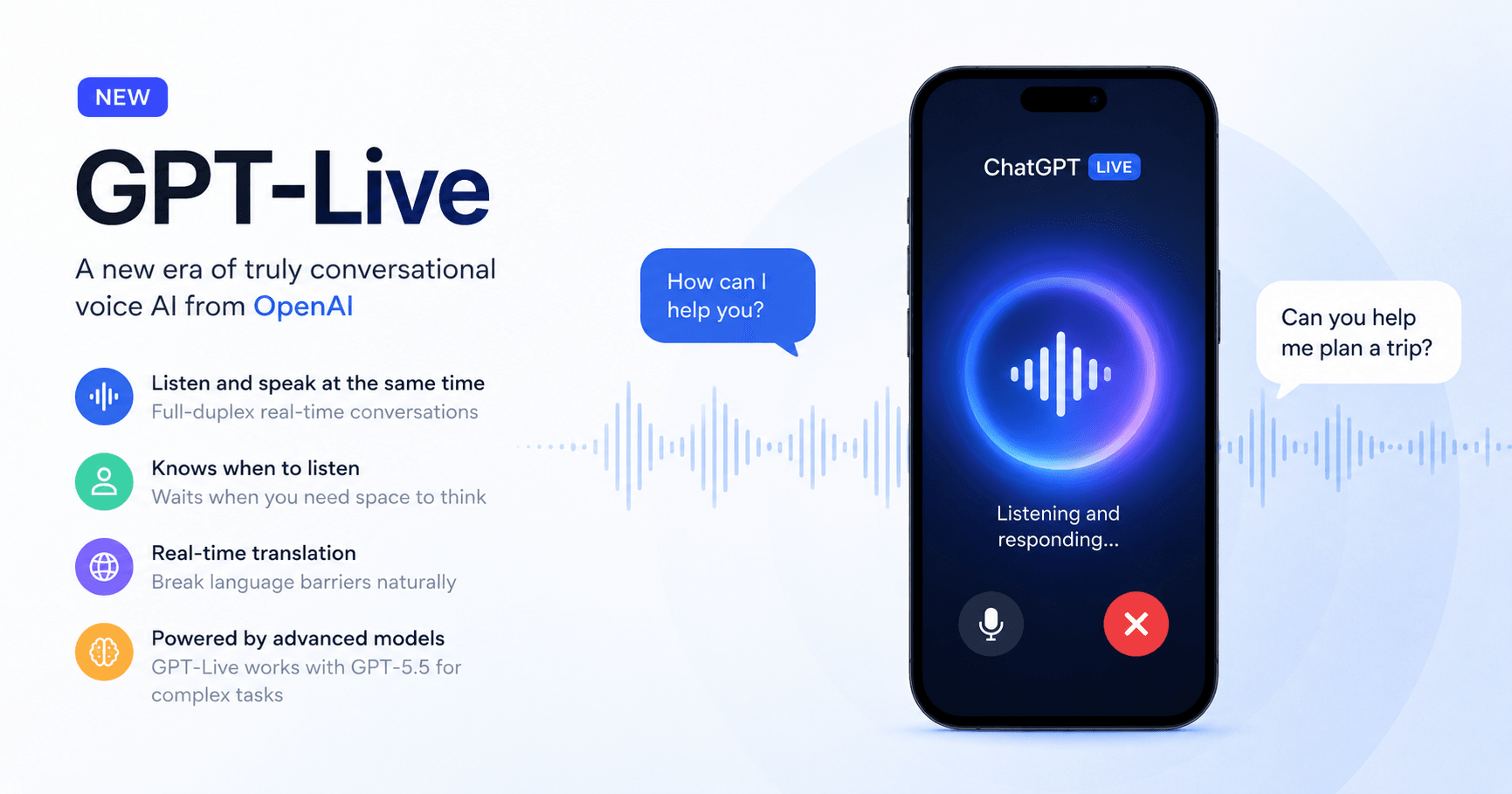

OpenAI has officially introduced GPT-Live, a new generation of voice models that completely changes how we interact with artificial intelligence. Instead of the traditional "speak, wait for a response, then continue" approach, GPT-Live can listen and speak at the same time, making conversations feel much more natural and human.
This new technology powers ChatGPT Voice and represents one of OpenAI's biggest advances in real-time voice interaction.
What is GPT-Live?
GPT-Live is a family of models designed specifically for real-time voice conversations. Its biggest innovation is a full-duplex architecture, allowing the AI to listen while responding instead of waiting for the user to finish speaking.
In practice, this removes the artificial pauses that have long been a limitation of traditional voice assistants.
The result is a much smoother experience where interruptions, topic changes, and spontaneous conversations happen naturally.
Key Features
More Natural Conversations
GPT-Live can:
Listen and respond simultaneously.
Understand pauses without interrupting the user.
Handle interruptions naturally during conversations.
Maintain context without requiring users to repeat information.
These improvements make talking with ChatGPT feel much closer to having a conversation with another person.
The AI Knows When to Stay Silent
Another major improvement is GPT-Live's ability to simply listen for extended periods when appropriate.
For example, you can say:
"Only answer when I'm finished."
"Just listen to the conversation."
"Wait until I ask a question."
During this time, the model continues following the conversation without interrupting unnecessarily.
Better Context Understanding
Because GPT-Live continuously follows the conversation in real time, it can naturally understand topic changes, correct misunderstandings, and maintain context without feeling like it's restarting after every question.
This significantly reduces the experience of talking to what feels like a traditional chatbot.
Real-Time Translation
Another announced capability is live translation during conversations.
This allows ChatGPT to act as an interpreter between two languages while preserving the natural flow of the discussion.
Powered by OpenAI's Most Advanced Models
Although conversations are handled by GPT-Live, more complex requests can automatically be delegated to more capable models such as GPT-5.5.
This means users benefit from fast conversational responses while still receiving advanced reasoning, research, and problem-solving whenever needed.
Availability
According to OpenAI:
Free users receive GPT-Live-1 mini.
Go, Plus, and Pro subscribers receive the full GPT-Live-1 experience.
The global rollout began on July 8, 2026, across the web, Android, and iOS.
Why This Matters
Until now, nearly every voice assistant has relied on a turn-based interaction model: the user speaks, the AI processes the request, and only then provides a response.
GPT-Live changes that.
The AI can now follow conversations in real time, understand interruptions, wait when appropriate, and respond much more naturally.
This represents a major step toward truly conversational AI and opens the door to more advanced applications, including personal assistants, customer support, live translation, education, meetings, and real-time collaboration.
GPT-Live marks the beginning of a new generation of voice interfaces, where interacting with AI no longer feels like issuing commands—it feels like having a genuine conversation.

Комментарии0
Пожалуйста, войдите, чтобы оставить комментарий.