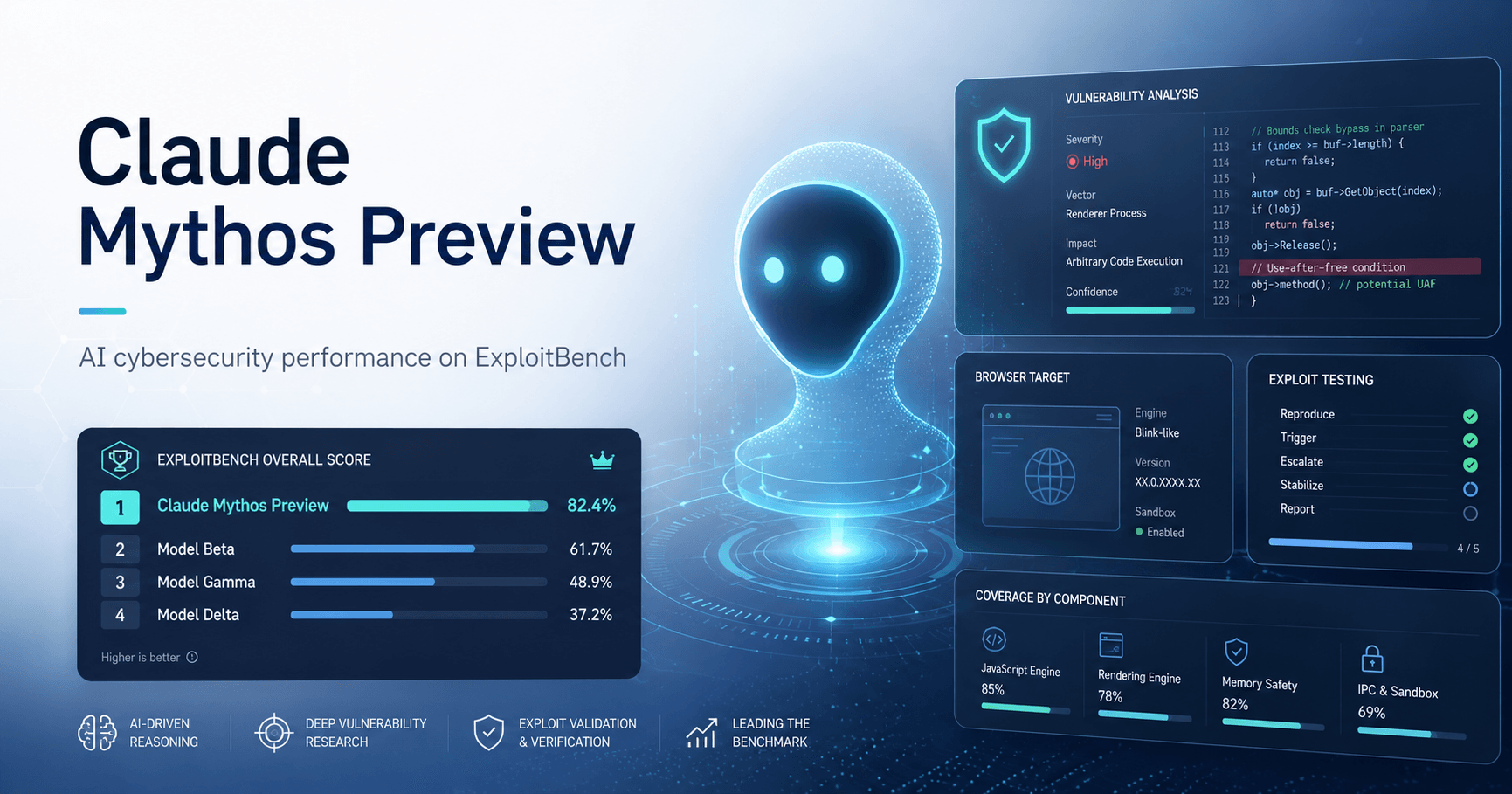

Claude Mythos Preview drew attention on ExploitBench by showing an important step forward in the use of artificial intelligence for complex cybersecurity tasks. ExploitBench is a benchmark created to measure how far AI models can go in analyzing and exploiting real vulnerabilities, especially in V8, the JavaScript engine used in browsers like Chrome and Edge, as well as environments like Node.js.
Unlike simple tests, ExploitBench organizes its evaluation as a kind of capability ladder. The model starts with more basic tasks, such as reaching a vulnerable part of the code, and can advance to much harder levels, such as reproducing crashes, creating exploitation primitives, and, at the highest level, achieving full control with arbitrary code execution.
In this context, Mythos Preview was one of the best-performing models. It appeared at the top of the ranking, outperforming other evaluated models and showing advanced ability in technical reasoning, hypothesis testing, debugging, and adaptation during long tasks. According to observations published by ExploitBench itself, Mythos’ runs resembled the work of a skilled security researcher focused on browsers and JavaScript engines.
The most relevant point is that Mythos did not only identify superficial signs of flaws. In several cases, it was able to move through complex stages until reaching high-impact results. This shows that AI models are becoming stronger in activities that require deep understanding of software, memory, sandboxing, and real system behavior.
At the same time, this progress raises an important discussion. The same capability that can help security teams reproduce flaws, assess severity, and prioritize fixes can also lower the technical barrier for attacks. For this reason, benchmarks like ExploitBench are important: they help measure these risks in a controlled way and provide more visibility into what advanced models can already do.
In short, Claude Mythos Preview represents a new phase for AI applied to cybersecurity. It shows that language models are not only useful for answering questions or generating regular code, but can also work on deep technical problems. For defensive teams, this can accelerate research, audits, and fixes. For the market, it is a clear sign that digital security will need to closely follow the evolution of AI agents.



Комментарии0
Пожалуйста, войдите, чтобы оставить комментарий.