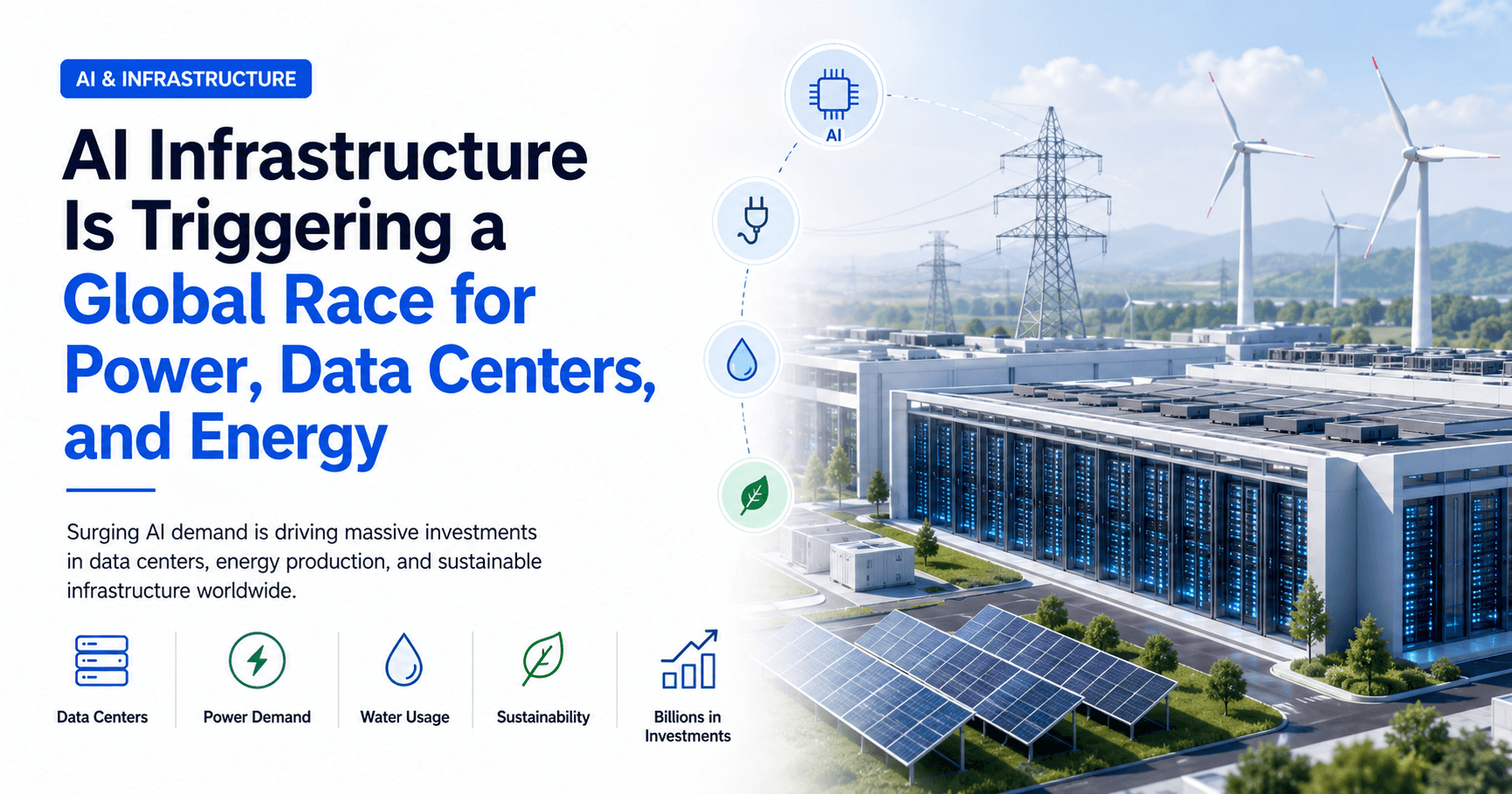

Artificial intelligence is no longer just a software revolution. It has become an infrastructure revolution.
Behind every AI model, chatbot, image generator, and autonomous system is an enormous network of data centers powered by thousands of high-performance GPUs. As demand for AI accelerates worldwide, technology companies are investing hundreds of billions of dollars—not only in computing hardware, but also in the electricity needed to keep these systems running.
The competition is no longer just about building the smartest AI. It is increasingly about securing enough energy to power it.
The New Bottleneck: Electricity
For years, cloud infrastructure was the primary challenge for AI companies. Today, electricity has become one of the industry's biggest limiting factors.
According to Reuters, investors are now acquiring power generation companies and energy developers to ensure future AI data centers have reliable access to electricity. Instead of waiting years for grid connections, companies are attempting to own both the digital infrastructure and the power infrastructure that supports it.
This represents a major shift in strategy.
Rather than treating electricity as an external service, major AI infrastructure investors increasingly see energy generation as a core business asset.
Billions Are Being Invested
The AI boom has sparked one of the largest infrastructure investment waves in recent history.
Technology companies are pouring billions of dollars into:
New hyperscale data centers
Advanced AI chips
High-capacity electrical grids
Renewable energy projects
Battery storage systems
Natural gas power plants
Nuclear energy initiatives
These investments are designed to support the next generation of AI models, which require exponentially more computing power than previous systems.
AI's Environmental Challenge
The rapid expansion of AI also brings significant environmental concerns.
Researchers from the United Nations University estimate that by 2030, global data center electricity and water consumption could roughly double as AI adoption continues to grow.
The report warns that AI infrastructure could require:
Nearly twice today's electricity consumption
Massive increases in cooling water usage
More land dedicated to data centers
Growing volumes of electronic waste
As larger AI models require increasingly powerful hardware, energy efficiency has become one of the industry's biggest engineering challenges.
Building Faster Than the Grid
Another challenge is timing.
Constructing a modern data center often takes far less time than expanding the electrical grid needed to support it.
Because of this, infrastructure investors are increasingly purchasing companies that already own or develop:
Solar farms
Wind projects
Battery storage
Natural gas generation
Transmission infrastructure
Owning both computing facilities and power assets allows companies to deploy AI infrastructure much faster while reducing long-term energy uncertainty.
Sustainability Is Becoming a Competitive Advantage
The AI industry is also under growing pressure to improve transparency around its environmental footprint.
Governments, researchers, and environmental organizations are calling for greater disclosure of:
Electricity consumption
Water usage
Carbon emissions
Cooling technologies
Renewable energy adoption
Many technology companies are already investing in more efficient cooling systems, liquid cooling technologies, and renewable energy to reduce operating costs while improving sustainability.
The Future of AI Depends on Infrastructure
The next phase of AI will not be determined only by better algorithms.
Success will increasingly depend on who can build and operate the world's largest, fastest, and most energy-efficient infrastructure.
Access to electricity, water, advanced chips, and reliable power generation is becoming as important as breakthroughs in AI research itself.
The race to develop artificial intelligence has quietly become a race to build the infrastructure that makes it possible.
As AI continues transforming industries around the world, the companies that secure both computing power and energy resources may gain the strongest competitive advantage over the next decade.



评论0
请登录后发表评论。