
Artificial intelligence is entering a new phase.
For a long time, AI models were mainly known for answering questions, writing texts, and generating code. Now, the competition is changing. Companies want to create models capable of understanding a goal, analyzing information, using tools, correcting their own mistakes, and continuing to work until a task is completed.
This is exactly the scenario in which Kimi K3, the new model from Moonshot AI, appears.
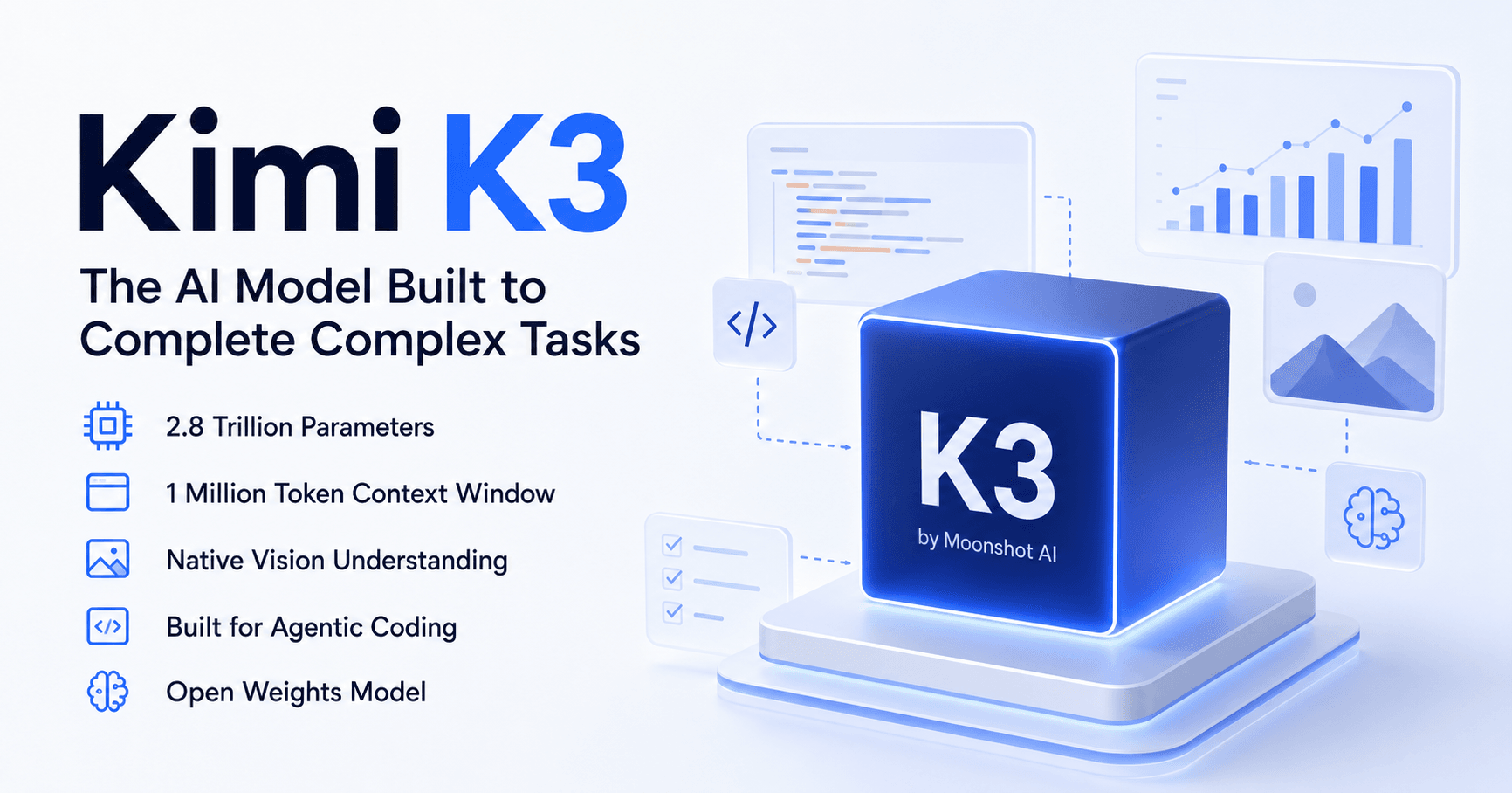
Presented as a frontier artificial intelligence model with open weights, Kimi K3 arrives with an impressive scale: 2.8 trillion parameters, a context window of up to 1 million tokens, and native support for understanding images. The proposal is to go beyond simply having conversations with users.
The goal of K3 is to help complete entire workflows.
A Massive Model with a Different Architecture
The number 2.8 trillion parameters immediately stands out. However, the model's size is not its only innovation.
Kimi K3 uses an architecture based on Mixture of Experts, also known as MoE. Instead of activating the entire model for every task, only a portion of the experts is used at any given moment.
K3 has a total of 896 experts, but only 16 are activated at a time.
This approach allows the model to have enormous overall capacity without necessarily needing to use all of its resources for every response.
Moonshot AI also introduced two important technologies into the model's architecture: Kimi Delta Attention and Attention Residuals.
Kimi Delta Attention was developed to better handle extremely long contexts. Attention Residuals, meanwhile, help the model retrieve information from different levels of depth during processing.
According to the company, these changes contributed to approximately 2.5 times greater scaling efficiency compared to Kimi K2.
A 1 Million Token Context Window
One of Kimi K3's most impressive features is its context window of up to 1 million tokens.
In practice, this means that the model can work with an enormous amount of information in a single session.
Imagine, for example, giving the model:
• an entire software project
• hundreds of documents
• extensive reports
• large knowledge bases
• code distributed across many files
Instead of analyzing only small sections, the model can work with a much broader view of the material.
This capability is especially important for programming, research, document analysis, and tasks that require keeping track of large amounts of information over time.
From Generating Code to Working on Entire Projects
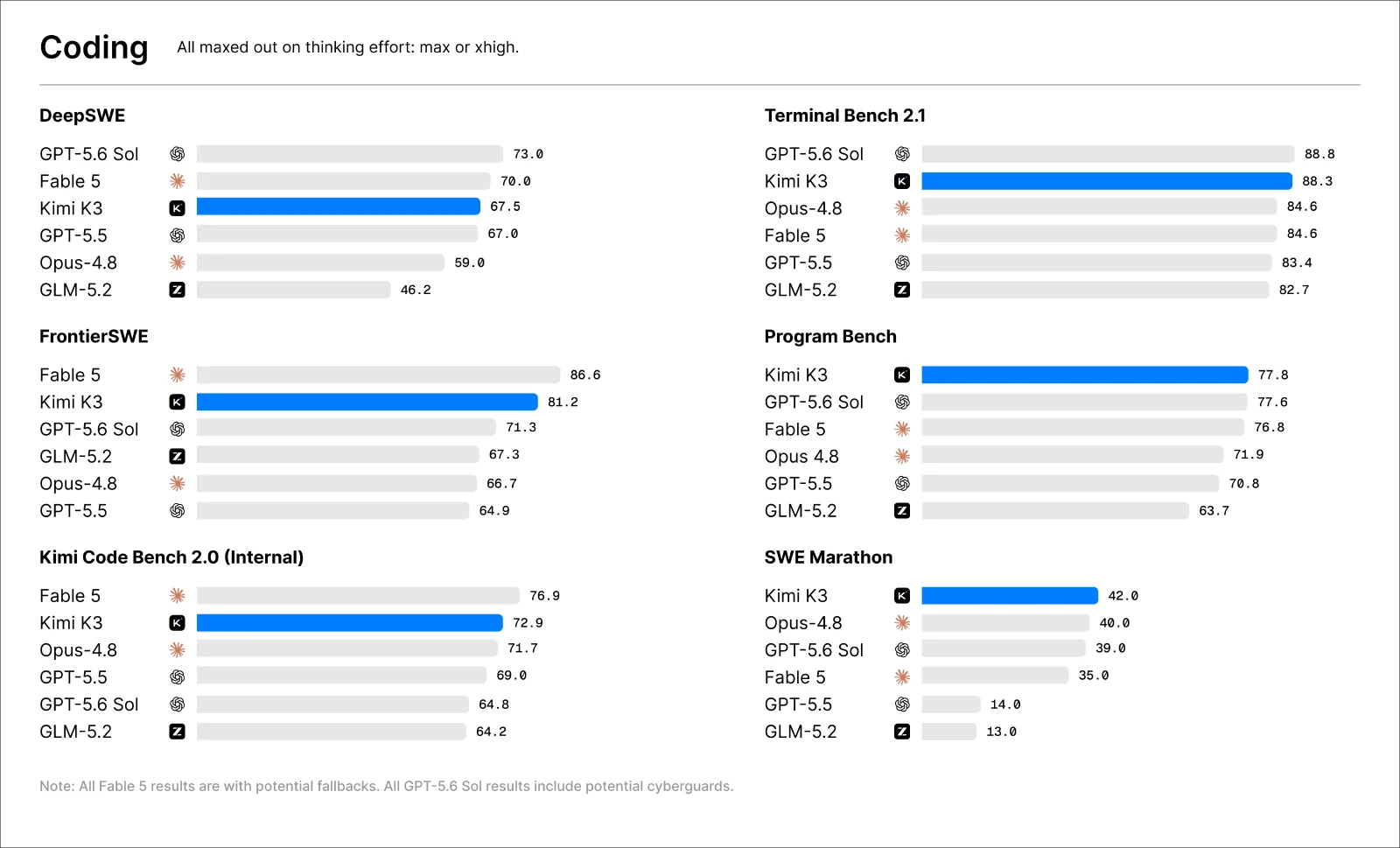
One of Kimi K3's main focuses is programming.
The idea is not simply to ask the model to create a function or fix a single line of code. K3 was designed to work on longer tasks.
It can analyze a large repository, understand how different files are connected, use tools, run tests, analyze the results, and continue making changes.
This type of behavior represents an important shift in the way we use AI for programming.
Instead of:
“Write this code.”
The idea becomes:
“Analyze this project, find the problem, implement the solution, run the tests, and fix whatever is necessary.”
This is the concept of agentic coding.
The model does not simply produce an answer. It participates in a process.
Vision Is Also Part of the Process
Another important feature of Kimi K3 is its native multimodal capability.
The model can work with both text and images, allowing it to analyze screenshots, charts, diagrams, interfaces, and other visual elements.
But the proposal goes beyond simply “looking” at an image.
In a workflow, the model can write code, visually observe the result, and make changes based on what it finds.
This opens up interesting possibilities for interface development, games, animations, and 3D applications.
Artificial intelligence can create something, observe the result, and continue refining the work.
Knowledge, Documents, and Presentations
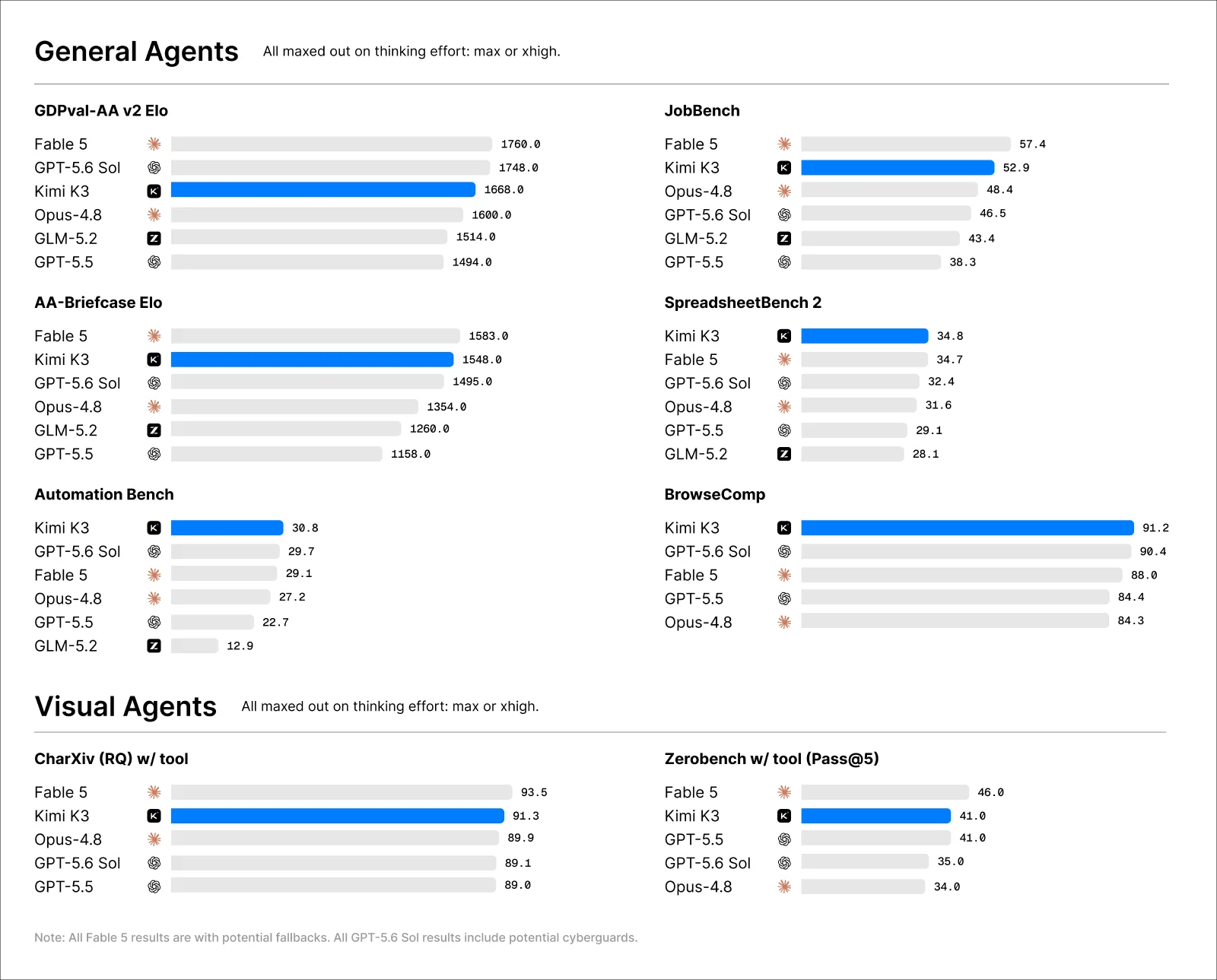
Kimi K3 was also designed with professional tasks in mind.
Moonshot AI positions the model for activities such as research, document creation, spreadsheet analysis, presentations, and the production of materials based on large amounts of information.
This means that the model can be used not only to answer questions, but also to transform scattered information into a more useful final result.
For example, instead of simply summarizing several documents, AI can analyze the sources, identify the most important points, and help create a report, presentation, or structured analysis.
The difference lies in moving beyond the simple “question and answer” model.
K3 was designed to work toward a goal.
An Open Model at an Unprecedented Scale
Another important aspect of the launch is the proposal to make the model's weights available.
Moonshot AI states that Kimi K3 will be the first open model in the 3-trillion-parameter class, with the complete weights planned to be released by July 27, 2026.
This could have a significant impact on artificial intelligence development.
Closed models are directly controlled by the companies that created them. Models with open weights, on the other hand, can allow researchers and companies to study, adapt, and develop new applications based on the technology.
Kimi K3, therefore, does not simply represent the launch of another chatbot.
It is also part of an increasingly intense race to develop advanced AI models that can be used by different companies and developers.
Is Kimi K3 the Best AI Model in the World?
Not necessarily.
Moonshot AI itself acknowledges that Kimi K3 still falls behind the most advanced proprietary models in overall performance and user experience.
This is important because impressive numbers do not mean that the model is superior at absolutely every task.
Each model has its own strengths.
Kimi K3 appears to stand out especially in tasks that require:
• extended reasoning
• programming across large projects
• tool use
• analysis of large volumes of information
• visual understanding
• executing complex tasks over long periods
In some situations, a smaller or more specialized model may be faster and more efficient.
In addition, the company itself warns that K3 can be overly proactive when instructions are ambiguous. In other words, it may make decisions that the user did not expect.
For this reason, clearly defining the desired limits and behavior remains important.
The Big Change: From Answering to Executing
Perhaps the most important characteristic of Kimi K3 is not the number of parameters or the size of its context window.
The most important change lies in the direction artificial intelligence models are taking.
AI is moving beyond being seen only as a tool that answers questions.
The next step is to create systems capable of receiving a goal and working toward it.
Analyzing information.
Planning steps.
Using tools.
Taking action.
Checking results.
Correcting mistakes.
And continuing until a conclusion is reached.
Kimi K3 represents exactly this trend.
It was created to handle long and complex tasks, especially in programming, research, digital creation, and professional work.
It is still too early to know the model's real impact or how it will perform against its main competitors in different situations. However, its launch shows something important: competition in the artificial intelligence sector is becoming increasingly intense.
At the same time, AI models are beginning to change their role.
The question is no longer simply:
“Which AI gives the best answers?”
The new question may be:
“Which AI can actually get the work done?”


评论0
请登录后发表评论。