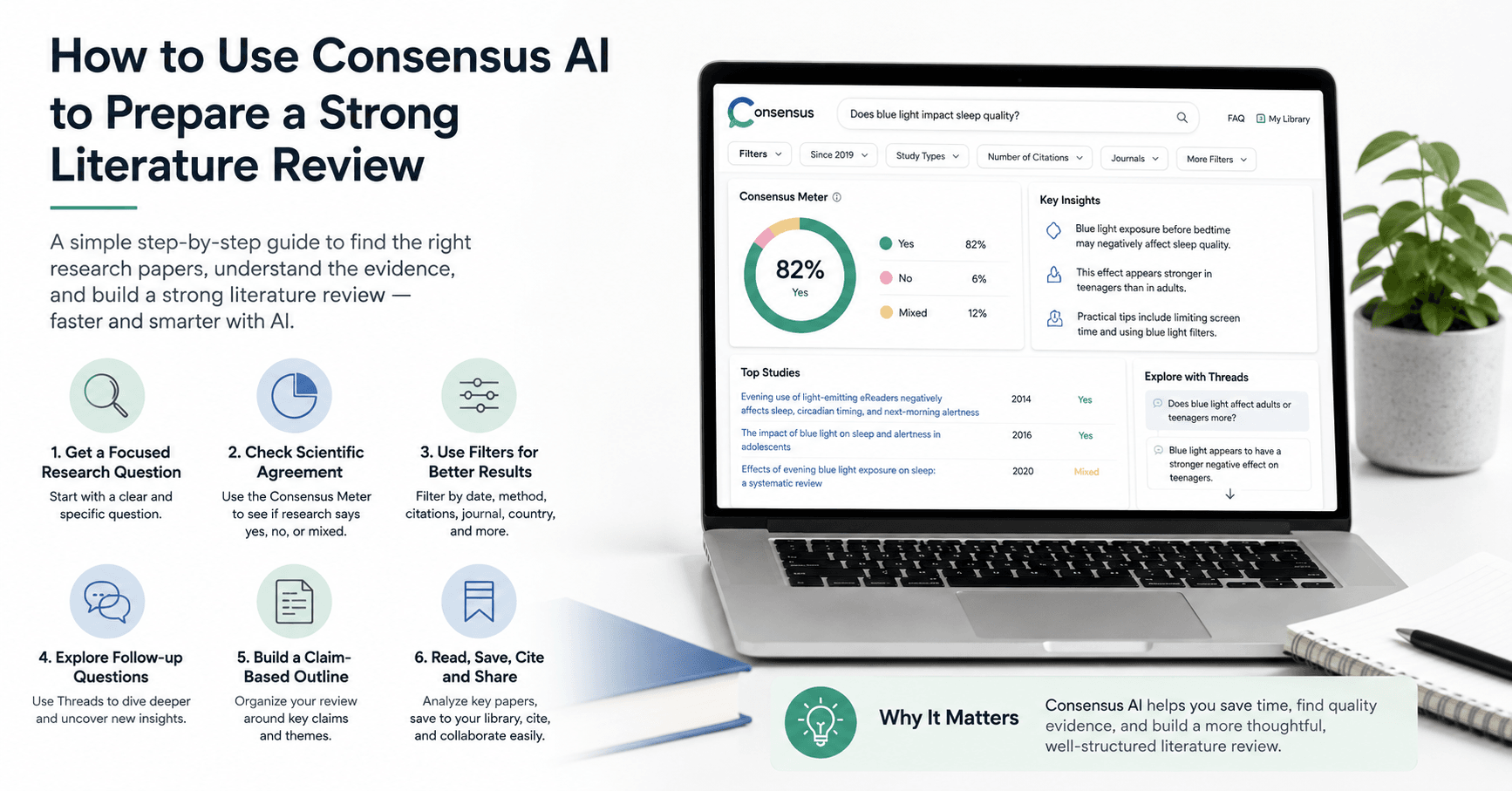

Writing a literature review is not just about putting words on a page. The real challenge comes before the writing begins: choosing a focused research question, finding the right papers, understanding the evidence, asking follow-up questions, and building a clear outline.
This preparation stage often takes a lot of time, especially when you are using tools like Google Scholar or PubMed manually. Consensus AI helps speed up this process by using artificial intelligence to search, summarize, and organize scientific research papers.
For students, researchers, and academic writers, it can be a powerful way to prepare a stronger literature review with less confusion and more evidence.
Start With a Focused Research Question
Every good literature review begins with a clear research question. Without one, it becomes difficult to know what to search for, what papers to include, and how to structure your argument.
A focused question sets boundaries. It tells you exactly what kind of evidence you need and prevents your review from becoming too broad or vague.
For example, instead of starting with a general topic like “sleep and technology,” you could ask:
“Does blue light impact sleep quality?”
This type of question is specific enough to guide the research process, but still broad enough to find useful academic papers.
Use Consensus AI to Check the Scientific Agreement
Consensus AI works like a research search engine powered by artificial intelligence. You enter a question, and the platform searches through scientific papers to provide an evidence-based answer.
One of its most useful features is the Consensus Meter. This tool shows whether the research leans toward “yes,” “no,” or “mixed.”
For example, when asking “Does blue light impact sleep quality?”, the tool may show that most relevant papers support the idea that blue light does affect sleep. Some studies may disagree, while others may show mixed results.
This is extremely useful for a literature review because a strong review should not only present one side. It should explain the dominant evidence while also recognizing studies that disagree or offer a more complex view.
Instead of reading hundreds of papers just to understand the general direction of the evidence, Consensus gives you a high-level overview much faster.
Use Filters to Find Better Papers
Consensus also allows you to filter your results. This makes the search more accurate and helps you focus on the most relevant studies.
You can filter papers by publication date, citation count, methodology, journal, country, and access type. For example, you may choose to focus only on systematic reviews, recent studies, or open-access papers.
This is important because not every paper has the same value for your literature review. A recent systematic review may be more useful than an older study with limited data. By using filters, you can reduce noise and focus on papers that are more credible and relevant to your question.
Explore Follow-Up Questions With Threads
A literature review becomes stronger when you go deeper than the first answer. Consensus AI includes a feature called Threads, which allows you to ask follow-up questions within the same research search.
For example, after asking whether blue light impacts sleep quality, you might ask:
“Does blue light affect adults or teenagers more?”
This helps you break your main question into smaller subtopics. In the transcript, the answer suggested that blue light exposure before bedtime may have stronger negative effects on teenagers due to greater sensitivity in their system.
This kind of follow-up insight can help you create a more detailed literature review. You might decide to include a section about age differences, mechanisms, sleep patterns, or risk groups.
Threads help you move from a simple question to a more complete academic argument.
Build a Claim-Based Outline
Before writing, you need an outline. A literature review usually contains several claims, arguments, and discussion points. Without structure, it is easy to lose focus.
A claim-based outline organizes your review around the evidence you found.
For example, your outline could include:
Evidence supporting the main effect
Studies showing mixed results
Alternative explanations
Differences between groups, such as adults and teenagers
Practical implications and research gaps
This structure helps you write with more clarity. Instead of simply listing papers, you are building an argument based on what the research shows.
Read Key Papers in More Depth
AI can help you find and summarize papers, but it should not replace deeper reading. Once you have identified the most important studies, you still need to examine them carefully.
Consensus makes this easier with paper-level insights. You can open a specific paper and ask questions such as:
“What are the main findings?”
“What methods were used?”
“What are the limitations of this study?”
The methods are especially important. Two studies may reach different conclusions because they used different populations, measurements, sample sizes, or experimental designs. Understanding these differences helps you write a more critical and balanced literature review.
A first-class literature review does not just say what the studies found. It explains why studies may agree, disagree, or produce mixed results.
Save, Cite, and Share Your Research
Another useful part of Consensus is the ability to save papers into your library. As you find useful studies, you can organize them into lists and return to them later.
You can also generate citations in different formats, which helps when preparing academic work. In addition, you can share papers or even entire research threads with classmates, colleagues, or members of your research group.
This makes Consensus useful not only for individual work, but also for collaborative research.
Why Consensus AI Helps With Literature Reviews
Consensus AI is valuable because it speeds up the preparation stage of academic writing. It helps you find relevant papers, understand the general agreement in the literature, explore follow-up questions, organize claims, and identify studies worth reading more deeply.
It does not write the literature review for you, and it should not replace your own critical thinking. However, it gives you a much stronger starting point.
Instead of spending hours manually searching through databases, you can use Consensus to quickly understand the evidence landscape and then focus your energy on analysis, interpretation, and writing.
Final Thoughts
A strong literature review depends on strong preparation. Before you write, you need a clear question, reliable papers, a balanced understanding of the evidence, and a structured outline.
Consensus AI helps with each of these steps. It turns the research process into something faster, clearer, and easier to manage.
For anyone working on a dissertation, thesis, academic essay, or research project, Consensus can be a practical tool for building a more evidence-based and well-organized literature review.



टिप्पणियाँ0
टिप्पणी करने के लिए कृपया साइन इन करें।