
Anthropic has officially introduced Claude Opus 4.8, a new version of its most powerful model in the Claude family. The goal is not only to deliver more intelligence, but also to make the model more reliable, accurate, and useful for complex everyday tasks.
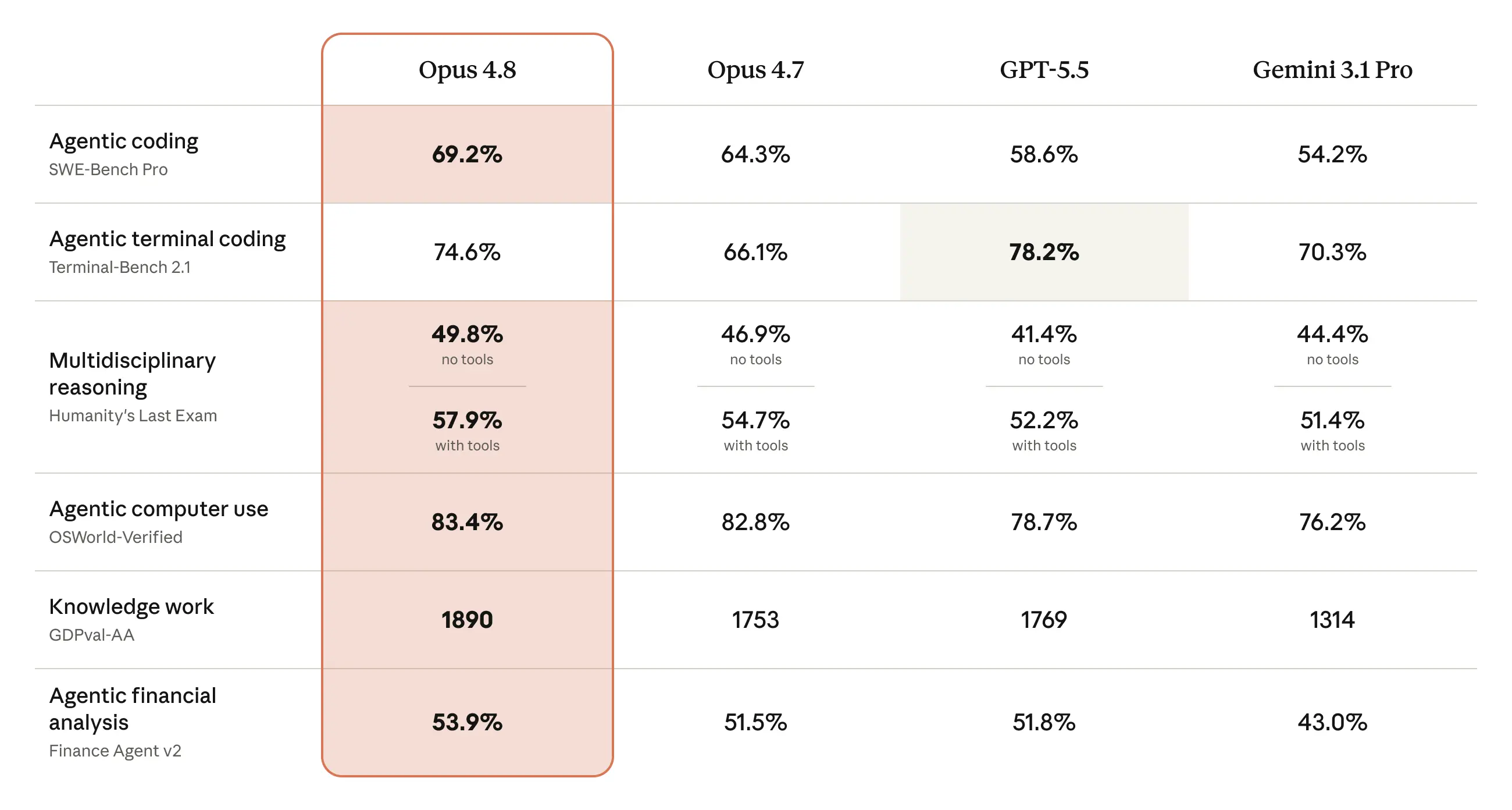
According to Anthropic, Opus 4.8 improves on Opus 4.7 with advances in coding, reasoning, tool use, agentic tasks, and work that requires deeper analysis. In practice, this means Claude is now better prepared to handle long projects, large codebases, detailed research, and professional workflows that require consistency.
What changes with Claude Opus 4.8?
The main promise of Claude Opus 4.8 is to be a better collaborator. Instead of simply responding quickly, the model has been improved to think more carefully, evaluate risks, notice errors, and act with more caution when it is unsure.
This matters because one of the biggest problems with AI models is their tendency to answer with confidence even when the response is not fully guaranteed. Anthropic says Opus 4.8 is more honest, more careful, and more likely to point out uncertainty in its own work.
For people using AI in professional tasks, this can be very important. A model that warns when something might be wrong is more useful than one that only delivers a polished answer without enough reliability.
Better performance in coding and AI agents
One of the biggest highlights of Claude Opus 4.8 is its performance in coding. Anthropic says the model performs better in coding tests, reasoning, and agentic tasks.
This means it can help more effectively with activities like reviewing code, fixing bugs, understanding large projects, suggesting improvements, and working through multi-step problems.
In Claude Code, one of the most important new features is dynamic workflows. With it, Claude can plan large tasks and divide the work among multiple subagents running in parallel. This makes it possible to handle bigger problems, such as migrations across codebases with hundreds of thousands of lines.
For development teams, this update makes Claude feel closer to a technical assistant capable of following long tasks from start to finish, instead of only answering isolated questions.
Effort control in responses
Another interesting new feature is effort control. Claude users can now choose how much effort the model should put into a response.
For simple tasks, users can select a lower level to get faster answers and use less of their usage limit. For difficult tasks, they can choose higher levels so Claude thinks more deeply before answering.
This makes the AI experience more flexible. Not every question needs maximum reasoning, but some tasks truly require deeper analysis. With this control, the user can choose the right balance between speed, cost, and quality.
More reliability for professional work
Anthropic also highlights that Claude Opus 4.8 has improved in areas such as financial analysis, legal documents, web browsing, tool use, and reading complex materials.
This reinforces Opus as a model designed for more serious and professional tasks. It is not just a chatbot for quick answers. The idea is that it can be used in workflows where accuracy, context, and responsibility matter.
Companies working with research, law, data, programming, and document analysis may benefit the most from this type of model, especially when they need an AI system that can stay consistent across long tasks.
Fast mode is now more accessible
Along with quality improvements, Anthropic also announced changes to Opus 4.8 fast mode. This mode allows the model to work faster, reaching up to 2.5 times the speed.
The company also says fast mode is now three times cheaper compared with previous models. This may make Opus more practical for situations where speed is essential, such as automations, agents, and high-volume workflows.
Pricing and availability
Claude Opus 4.8 is already available. For regular use, the price remains the same as Opus 4.7: $5 per million input tokens and $25 per million output tokens.
In fast mode, the listed price is $10 per million input tokens and $50 per million output tokens. Developers can also access the model through the API using the identifier claude-opus-4-8.
Is Claude Opus 4.8 worth using?
Claude Opus 4.8 appears to be an update focused on quality, reliability, and collaboration. It is not only about better benchmark numbers. The goal is to improve the real experience of people who use AI for work.
For simple tasks, cheaper or faster models may already be enough. But for advanced coding, document analysis, autonomous agents, complex decisions, and work that requires more care, Opus 4.8 positions itself as one of Anthropic’s strongest options.
The most interesting point is the combination of reasoning, honesty, and effort control. This gives users more control over how the AI works and helps reduce overly confident responses when the model should be more cautious.
Overall, Claude Opus 4.8 is an important evolution for anyone looking for a more mature, reliable, and professional AI model.




टिप्पणियाँ0
टिप्पणी करने के लिए कृपया साइन इन करें।