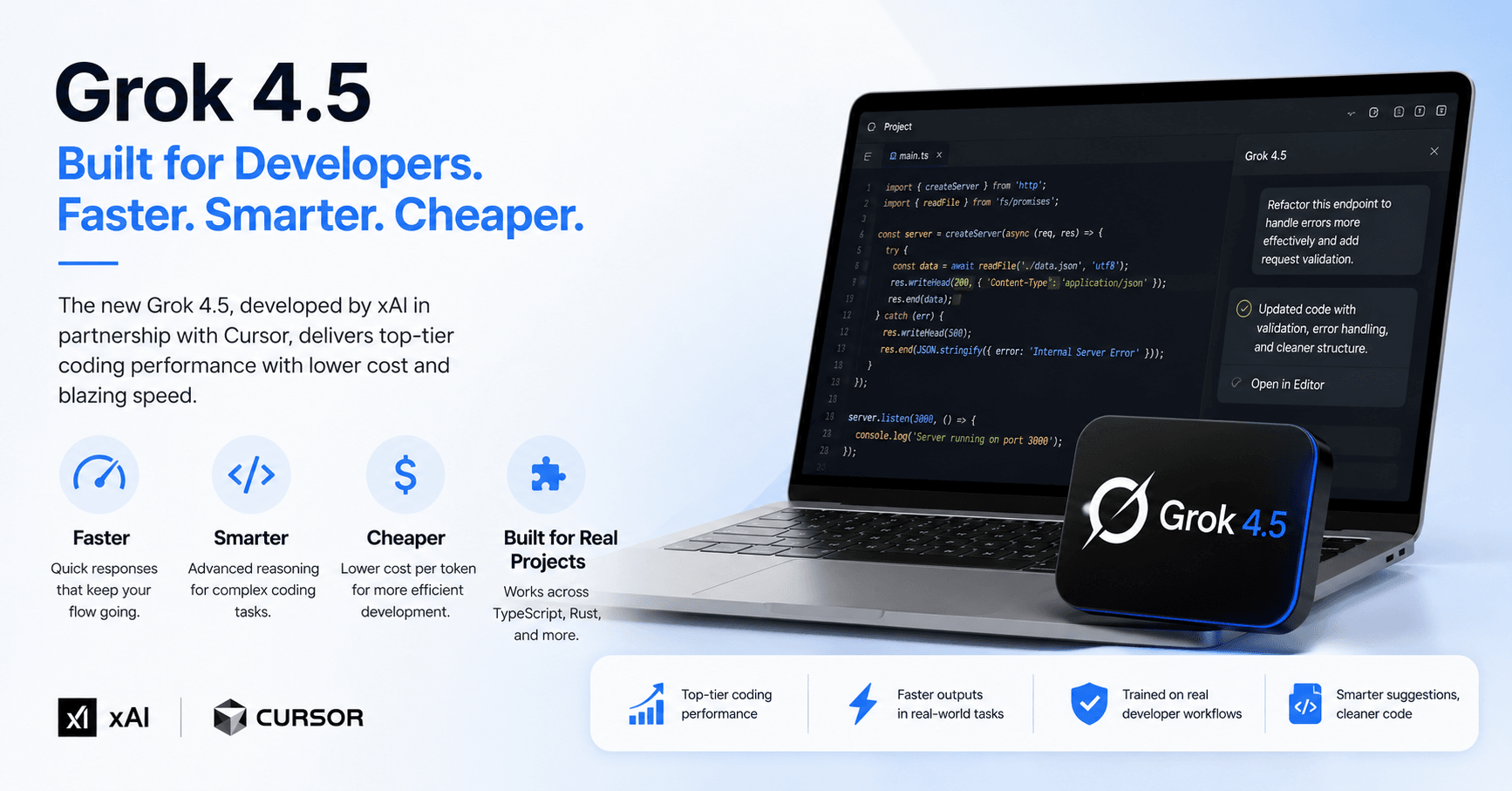

The competition among AI models designed for software development has a new serious contender. Grok 4.5, developed by xAI in collaboration with Cursor, has started attracting attention after multiple real-world tests revealed a dramatic leap over its previous versions.
For a long time, Grok was never considered a top-tier coding model. GPT-5.5 and Claude Opus consistently dominated programming tasks, especially when working with complex codebases. With the arrival of Grok 4.5, that landscape may be changing.
According to hands-on testing across production projects, the new model delivers code quality comparable to today's leading coding assistants while offering two major advantages: significantly faster responses and lower operating costs.
The Biggest Leap in the Grok Family
The most impressive aspect isn't simply the new version—it's how far it has advanced compared to Grok 4.3.
While previous Grok releases lagged behind the industry's strongest coding models, Grok 4.5 now competes directly with GPT-5.5 and Claude Opus on real software projects involving TypeScript, Rust, and Electron applications.
In one example, the model successfully resolved a Linux screen recording issue by analyzing both TypeScript and Rust code. Another competing model had attempted the same problem several times without producing a working solution.
Although this is only one case study, it highlights an important shift: Grok has evolved from a general-purpose assistant into a genuinely competitive coding model.
Benchmarks Only Tell Part of the Story
One of the most interesting points raised during testing is that benchmarks should not be treated as the ultimate measure of an AI model.
Benchmark scores can indicate strong performance, but they don't always reflect how a model behaves inside a real production codebase. In software engineering, understanding an existing architecture, following project conventions, and solving practical issues often matter more than benchmark rankings.
A good example is Cursor Bench. Grok 4.5 was intentionally excluded because an earlier snapshot of Cursor's own codebase had accidentally been included during training. Since that could influence the results, Cursor chose not to publish those benchmark numbers until an updated version becomes available.
That level of transparency reinforces an important point: benchmark rankings alone rarely tell the whole story.
Lower Cost and Better Efficiency
Beyond code quality, Grok 4.5 also stands out for its pricing.
The model costs considerably less per token than GPT-5.5 and Claude Opus. According to the published information, it also completes tasks using fewer tokens, making each request even more cost-effective.
For organizations running AI-powered development workflows at scale, that combination can translate into meaningful infrastructure savings.
Performance, speed, and efficiency together make Grok 4.5 an attractive option for AI-assisted software development.
Why the Cursor Partnership Matters
A significant part of this improvement appears to come from xAI's collaboration with Cursor.
During training, Grok 4.5 learned from trillions of tokens generated through real developer interactions inside Cursor. This includes accepted suggestions, rejected edits, follow-up corrections, and countless examples of how programmers actually work.
Rather than learning only from publicly available code, the model also learned from real development workflows.
This kind of data is particularly valuable because it captures information that rarely exists in open-source repositories, such as iterative improvements, refactoring decisions, and practical debugging strategies.
It Still Isn't Perfect
Despite the impressive progress, Grok 4.5 still has limitations.
Testing uncovered examples of unnecessary code, unused variables, and implementation choices that could have been improved. In one case involving semantic version comparisons, the model ignored an existing library designed specifically for the task and implemented a less reliable solution instead.
These kinds of mistakes are not unique to Grok. Similar issues continue to appear in GPT-5.5, Claude Opus, and other leading coding models.
Human review remains essential for production software.
A New Contender Among the Top Coding Models
Perhaps the biggest takeaway is that the market for AI coding assistants has become even more competitive.
For years, OpenAI and Anthropic largely dominated this space. Now, xAI appears to have entered the conversation with a model capable of matching their coding performance in many scenarios while delivering responses more quickly and at a lower cost.
It's still too early to claim that Grok 4.5 outperforms every competitor across every use case. Each model continues to have strengths depending on the programming language, project complexity, and workflow.
Even so, early real-world testing suggests that Grok 4.5 has evolved from an interesting alternative into one of the most compelling AI models currently available for software development.
For developers who rely on tools like Cursor every day, Grok 4.5 may become a strong new option when choosing an AI programming assistant.

Comentarios0
Inicia sesión para comentar.