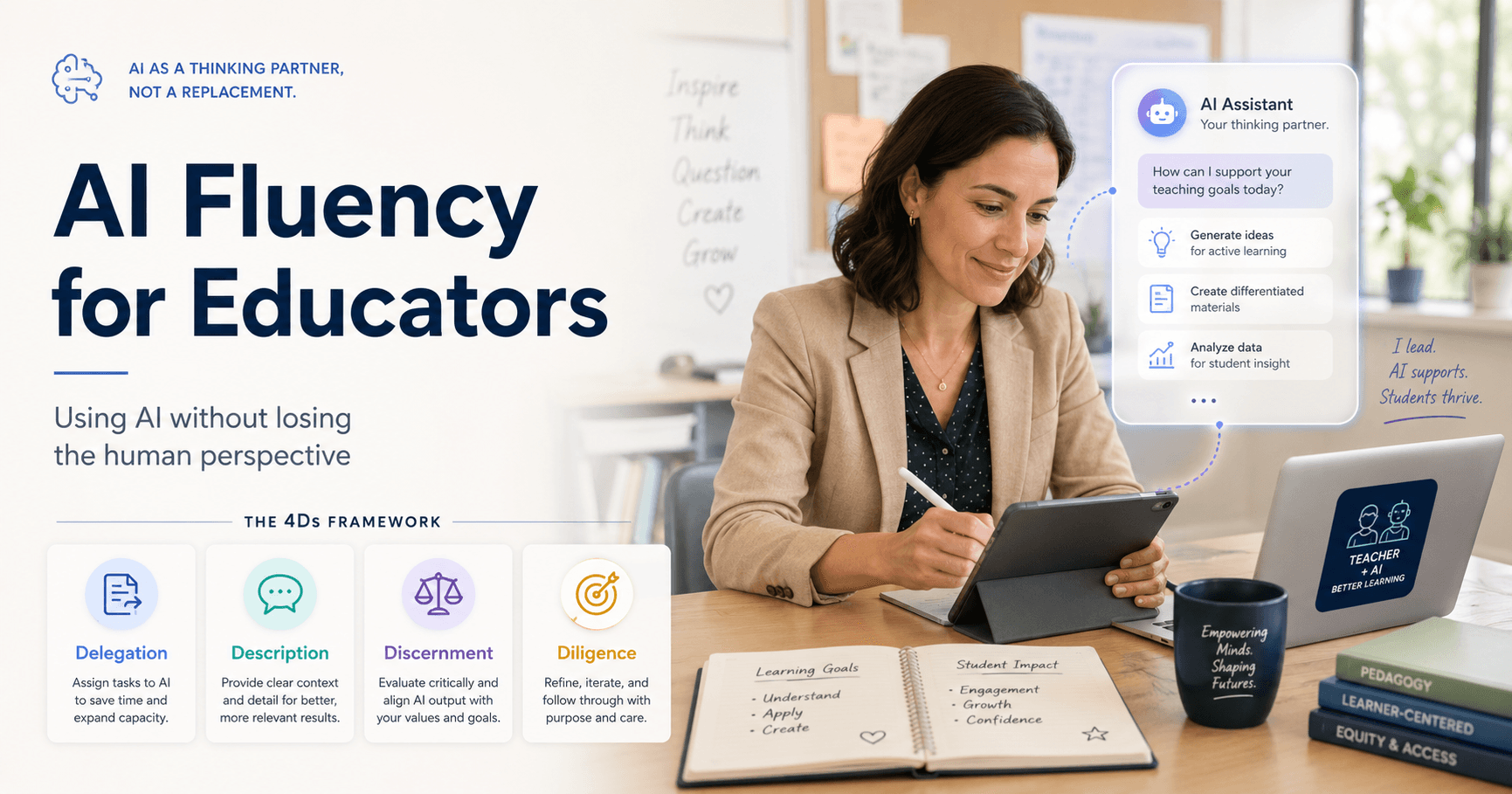

Artificial intelligence is already part of education. Students use AI to study, research, write, and organize ideas. Teachers can also use these tools to plan lessons, create materials, review activities, and improve the learning experience.
But using AI in education does not mean simply asking a tool for something and accepting the answer as final.
Effective AI use requires fluency. In other words, it means knowing how to collaborate with technology, when to trust it, when to review it, and how to keep pedagogical values at the center of the process.
This is where the AI Fluency Framework, also known as the 4Ds model, comes in: Delegation, Description, Discernment, and Diligence. This framework helps educators use AI as a thinking partner, not as a replacement for human expertise.
What Is AI Fluency?
AI Fluency is the ability to work well with artificial intelligence.
It is not only about knowing how to write prompts. It also involves understanding which task should be delegated, how to explain the context, how to evaluate the answers, and how to use AI responsibly.
In education, this is even more important.
AI can help with many parts of teaching work, such as:
• Course planning
• Creating learning objectives
• Organizing content
• Developing slides
• Creating quizzes
• Designing classroom activities
• Producing study guides
• Reviewing teaching materials
But the final decision still belongs to the educator.
AI can suggest possible paths, but the teacher is the one who understands the students, the class challenges, the discipline goals, and the institutional context.
The 4Ds of AI Fluency
The 4D Framework organizes AI use into four main skills.
1. Delegation
Delegation means understanding what should or should not be delegated to AI.
Before asking for something, the teacher needs to think:
• What is the goal of this task?
• What requires my pedagogical expertise?
• Where can AI truly help?
• Which tool is best suited for this activity?
For example, a teacher can use AI to generate initial activity ideas, but should not simply accept everything without checking whether it makes sense for their students.
AI can help speed up the process, but it should not take control of the pedagogical decisions.
2. Description
Description is the ability to clearly explain what you need.
The better the context you provide, the better the AI response tends to be.
Instead of asking:
“Create a lesson about artificial intelligence.”
It is much better to say:
“I am creating an introductory lesson about artificial intelligence for high school students. They have little technical knowledge, enjoy practical examples, and the lesson needs to last 50 minutes. I want to explain the concept of generative AI, show everyday examples, and finish with a group activity.”
This kind of description turns AI into a more useful partner because it better understands the scenario, the limits, and the goals.
3. Discernment
Discernment is critical judgment.
Even if AI provides a well-written answer, the educator still needs to evaluate:
• Is the information correct?
• Is the level appropriate for the students?
• Does the activity truly support learning?
• Is there any bias or risky oversimplification?
• Is the content aligned with the course objectives?
This is essential.
AI can produce convincing answers, but they are not always correct or appropriate. That is why the teacher needs to review, adapt, and explain back to the AI what worked and what did not.
This process creates an improvement loop: the teacher describes, the AI responds, the teacher evaluates, adjusts the request, and improves the result.
4. Diligence
Diligence involves responsibility, transparency, and care.
In practice, this means:
• Verifying important information
• Protecting students’ sensitive data
• Checking for bias in the content
• Documenting how AI was used
• Being transparent when necessary
• Keeping human responsibility over the final result
In education, this care is essential because AI use can directly affect learning, assessment, and students’ trust.
AI as a Thinking Partner
One of the most important points of AI Fluency is understanding the difference between automation and augmentation.
Automation is when you try to make AI do everything for you.
Augmentation is when you use AI to improve your own work.
In education, augmentation is usually much more powerful.
For example, a teacher can ask AI to suggest a sequence of lessons. Then, the teacher analyzes the proposal, removes what does not fit the class, improves the examples, and adjusts the language.
In this case, AI did not replace the teacher. It helped the teacher think better, compare possibilities, and refine the plan.
Building Context to Work Better With AI
One of the best ways to use AI in education is to create a teaching context document.
This document can include information such as:
• Who your students are
• What the subject is
• What the main goals are
• Which teaching methods you prefer
• What difficulties students usually have
• What institutional limitations exist
• How you assess learning
• Which pedagogical values are important to you
This context can be reused in new conversations with AI.
As a result, the tool stops responding in a generic way and starts collaborating in a way that is more aligned with your teaching style.
Practical Example
Imagine a teacher needs to create an activity about critical thinking.
A simple request would be:
“Create an activity about critical thinking.”
But a more fluent request would be:
“I am preparing a 30-minute activity for first-year university students. The goal is to help them identify weak arguments in AI-generated texts. The class has difficulty justifying answers, so I want a group activity with short examples, guided discussion, and a final individual reflection step.”
The second version provides context, goal, audience, class difficulty, desired format, and expected outcome.
The AI response will probably be much more useful.
Using AI to Create Learning Materials
Once the context is well defined, AI can help create more coherent learning materials.
It can support the production of:
• Lesson slides
• Revision guides
• Interactive exercises
• Quiz questions
• Case studies
• Assessment rubrics
• Group activities
But each material requires a different strategy.
For slides, the teacher can ask for an initial structure and then adjust the flow.
For quizzes, the teacher can request questions with different difficulty levels and explanations for each answer.
For classroom activities, the teacher can ask for instructions, estimated time, possible student responses, and alternatives in case the activity goes too fast or too slow.
The goal is not only to save time. It is to create better, clearer materials that are more connected to the learning objectives.
AI and Academic Integrity
One important challenge is that students also have access to AI.
This changes how teachers need to think about assignments and assessments.
Instead of creating tasks that can easily be answered by a tool, educators can design assessments that require reflection, application, justification, comparison, personal experience, or classroom discussion.
AI Fluency helps teachers create more authentic activities.
For example, instead of only asking for a summary, the teacher can ask for:
• A critical analysis of an AI-generated summary
• A comparison between two different answers
• A justification of which answer is better
• A revision based on defined criteria
• A reflection on the AI-use process
This way, AI stops being a threat and becomes part of the learning process.
Conclusion
Artificial intelligence can transform education, but only when used with intention, responsibility, and critical thinking.
The 4D Framework helps educators collaborate better with AI while keeping the focus on what really matters: student learning.
References: https://www.anthropic.com/learn




Comentarios0
Inicia sesión para comentar.