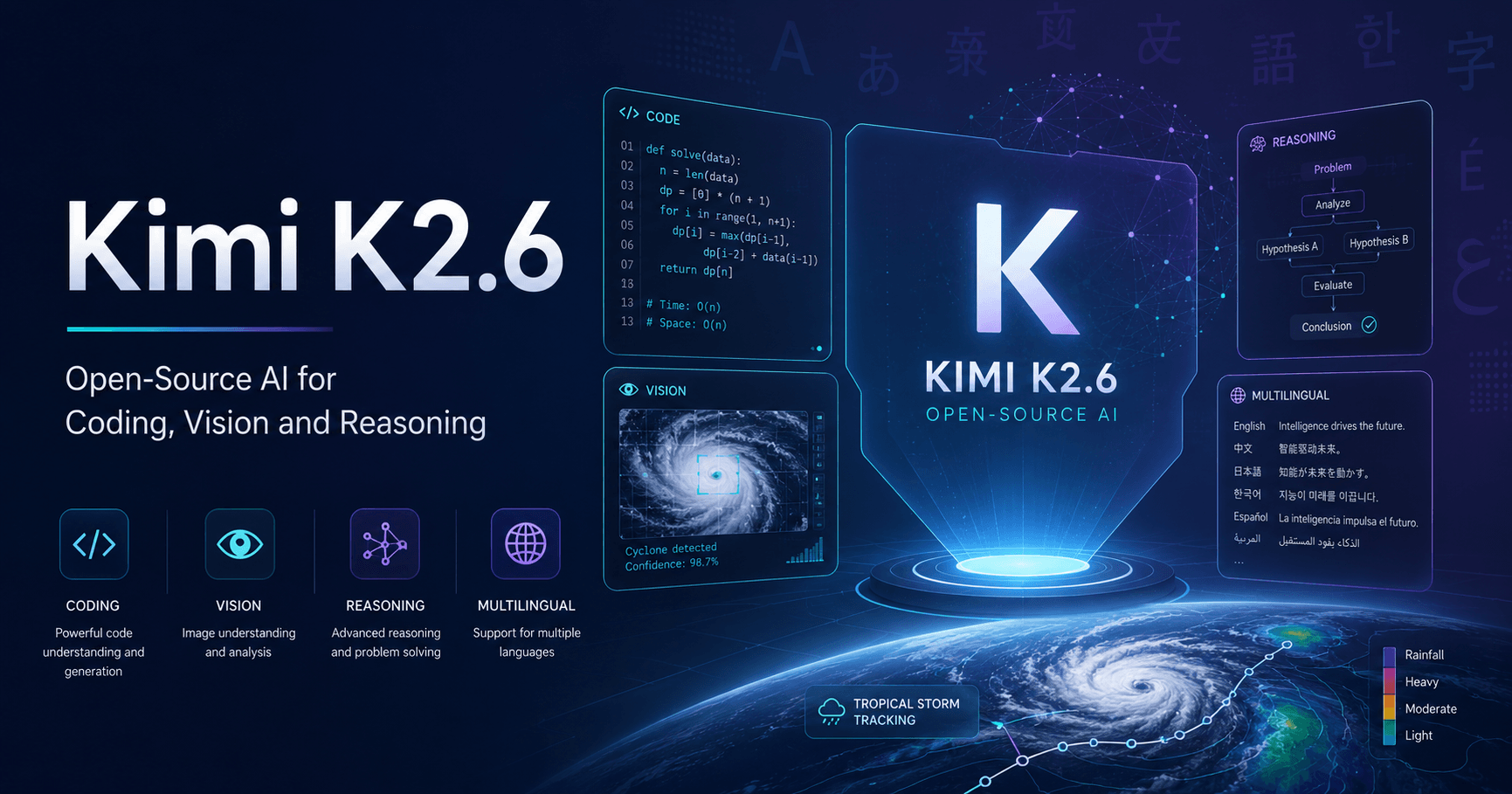

Kimi K2.6 is one of the most interesting open-source AI releases right now. It is not just another language model claiming to be powerful. In practical tests, it shows strong performance in coding, multilingual writing, image understanding, OCR, reasoning, and even complex simulations.
The most impressive part is that Kimi K2.6 was released with its model weights available from day one. That makes it especially important for developers, researchers, and AI enthusiasts who want more control, transparency, and flexibility instead of depending only on closed platforms.
What is Kimi K2.6?
Kimi K2.6 is a large open-source AI model created by Moonshot AI. It uses a Mixture of Experts architecture, also known as MoE.
In simple terms, this means the model has a very large total capacity, but it does not activate everything at once. Kimi K2.6 has around one trillion total parameters, but only about 32 billion are active during each response.
This makes the model more efficient. Instead of using the full model for every single task, it routes each token through only a small group of expert networks. According to the transcription, it uses 8 out of 384 expert networks at a time.
The result is a model that can be very powerful while still keeping inference more practical.
Kimi K2.6 also includes a 256K token context window, which means it can handle very long documents, large codebases, detailed prompts, and extended conversations. It also has a built-in vision encoder called MoonViD, allowing it to understand images and videos natively.
Why Kimi K2.6 matters
One of the biggest highlights of Kimi K2.6 is its improvement over the previous version.
In the video, the model is compared with Kimi K2.5 in coding benchmarks. Kimi K2.5 scored 57.4, while Kimi K2.6 reached 68.2. That is a large jump between two consecutive versions.
This matters because coding benchmarks are not only about writing small code snippets. Good coding evaluations usually test real-world programming tasks, code generation, debugging, and repository-level reasoning.
A jump like this suggests that Kimi K2.6 is not just slightly better. It may represent a meaningful improvement in training, architecture, or reasoning ability.
Testing Kimi K2.6 with a complex simulation
The first practical test in the transcription was a difficult coding prompt.
The model was asked to create an interactive simulation of a real-time monsoon supercell storm. The storm had to follow a historical migration path from the Ganges Plain in India, move westward across Rajasthan, pass through Sindh in Pakistan, intensify over water bodies, and include several atmospheric and visual details.
This is not a simple task.
The prompt tested whether Kimi K2.6 could understand a detailed natural language instruction and turn it into an interactive simulation. It also tested the model’s ability to plan, reason, search the web, execute Python code in a sandbox, and generate a working HTML file.
The result was impressive.
Kimi K2.6 created a single HTML file with no external dependencies. The simulation included a moving storm, atmospheric data, weather parameters, regional zones, changing day and night cycles, lightning, wind effects, trees moving, terrain changes, and even a rainbow.
Of course, the result was not perfect. Some visual details could still be improved. But the fact that the model generated a complete interactive weather simulation from one prompt is a strong sign of its coding and creative abilities.
Even more interesting, this test was done using instant mode, not thinking mode. That means the model produced a strong result without relying on its deeper reasoning mode.
Multilingual performance
The next test focused on multilingual writing.
The prompt asked Kimi K2.6 to write an excited one-line announcement about a fictional event where the northern lights appeared over Toronto, Niagara Falls, and Vancouver at the same time.
The model had to translate this announcement into 80 languages.
The result was mostly strong. According to the transcription, the outputs felt excited, creative, and culturally appropriate instead of mechanical. The model did not simply translate word by word. It tried to keep the emotion of the announcement alive across many languages.
However, it was not perfect. One issue mentioned was that the Tigrinya translation appeared to be identical to the Amharic translation, suggesting that the model may have confused two different languages.
Still, the overall multilingual performance seemed much better than expected. This is important because many AI models perform well in English but become weaker when dealing with regional or less common languages.
Kimi K2.6 appears to have made real progress in this area.
Creativity and humor in thinking mode
The video also tested the model’s creativity using thinking mode.
The prompt asked a philosophical and humorous question: what would different philosophers say about life or wife?
This type of task is harder than it looks because it requires style imitation, humor, cultural understanding, and subtle reasoning.
Kimi K2.6 answered with short, witty responses inspired by different thinkers. The transcription highlights that the model’s humor was subtle and that it generated creative responses without losing focus.
This shows that Kimi K2.6 is not only useful for technical tasks. It can also handle creative writing, playful reasoning, and abstract prompts.
OCR and image understanding
Another strong point of Kimi K2.6 is vision.
The model was given an Arabic text image and asked to identify the language, analyze the context, translate it, and explain its cultural and political meaning.
The response was described as accurate and detailed. Kimi K2.6 identified the Arabic script, translated the text into English, and explained the rhetorical structure, tone, and deeper meaning behind the content.
This is more than basic OCR.
Basic OCR only reads text from an image. Kimi K2.6 went further by interpreting the message, explaining the context, and analyzing the cultural layers behind it.
This makes the model useful for document analysis, historical texts, screenshots, social media posts, scanned pages, and multilingual research.
Understanding handwritten physics equations
One of the most impressive tests involved a handwritten image containing physics equations.
The model was asked to act as a physics professor, transcribe the equations, explain each one, and assess the content.
According to the transcription, Kimi K2.6 transcribed 28 equations accurately. It also explained their historical significance and organized the information into a detailed table.
The model recognized topics such as ultraviolet catastrophe, Einstein’s Nobel Prize work, special relativity, old quantum theory, and wave-particle duality.
This is important because the task required more than reading handwriting. The model had to understand the meaning of the equations, connect them to physics history, and identify the academic level of the material.
The transcription describes this as a sign of real understanding, not just pattern matching.
Kimi K2.6 for developers
For developers, Kimi K2.6 is especially exciting.
It can generate code, reason through programming tasks, work with complex prompts, create interactive projects, and potentially be deployed locally thanks to support for quantization.
The video also mentions future local deployment testing, which is one of the most important topics for open-source AI users. If a model can run locally with good performance, it becomes more useful for private projects, offline workflows, and companies that do not want to send sensitive data to external platforms.
Kimi K2.6 may become a serious option for people looking for alternatives to closed coding assistants.
Final thoughts
Kimi K2.6 feels like a major step forward for open-source AI.
It performs well in coding, simulation generation, multilingual writing, OCR, image analysis, reasoning, and scientific interpretation. It is not perfect, and some outputs still need human review, especially in languages where mistakes can be harder to detect.
But overall, the model shows a strong combination of speed, intelligence, creativity, and technical ability.
The biggest strength of Kimi K2.6 is not just that it can answer questions. It can work through complex tasks, use tools, interpret images, generate code, and explain difficult concepts in a structured way.
For developers, researchers, students, and AI enthusiasts, Kimi K2.6 is definitely a model worth watching. It shows how fast open-source AI is evolving and how close these models are getting to becoming practical everyday tools for serious work.






Comentarios0
Inicia sesión para comentar.