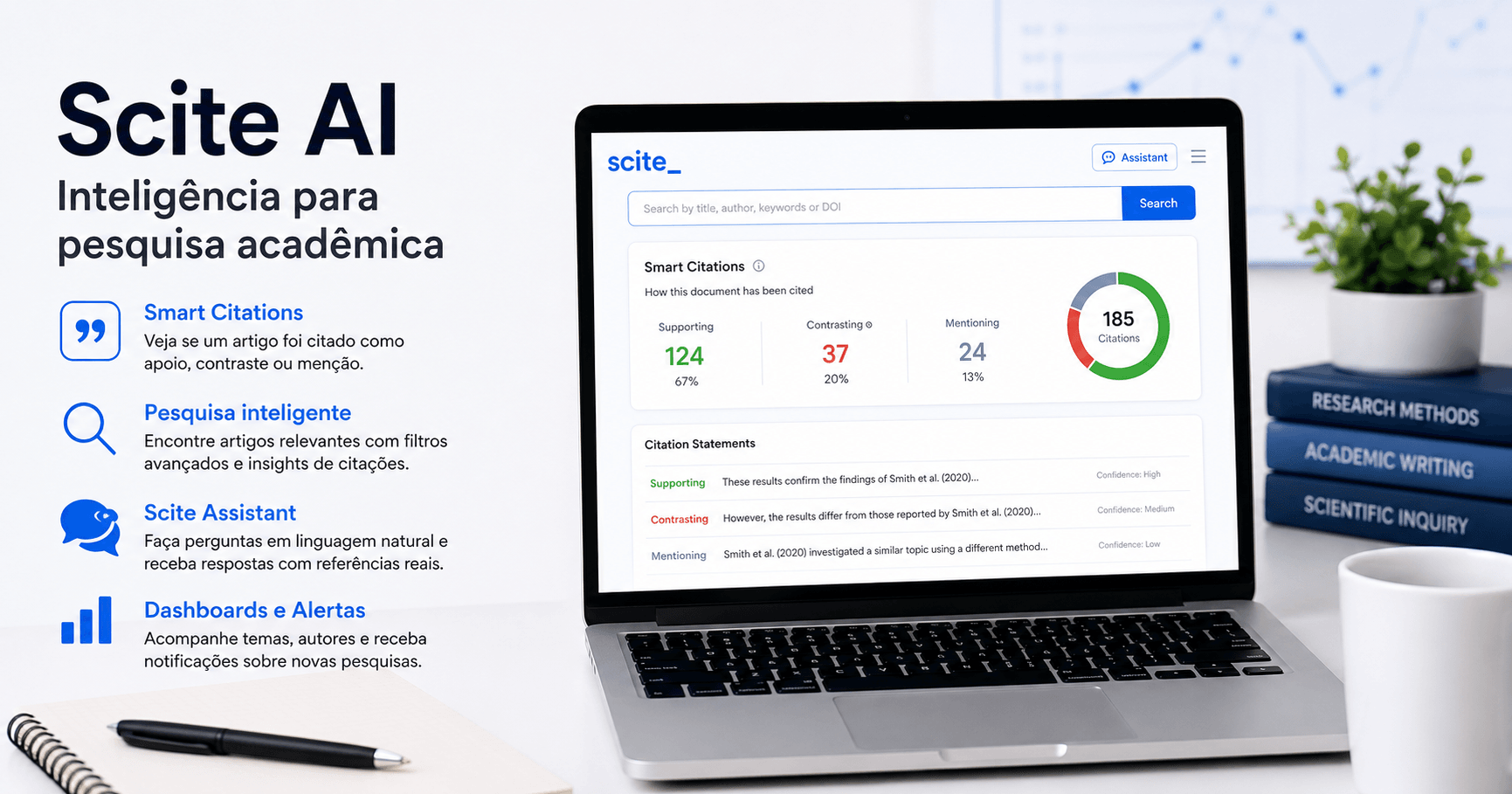

Scite AI is a platform designed to help students, researchers, and academic professionals find, analyze, and understand scientific articles with more confidence. Unlike a regular search tool, it does not only show how many times a study has been cited. Its main advantage is that it explains how that study was cited by other papers.
This is very important because not every citation means that an article was confirmed or supported. Sometimes, a study is cited because another researcher found similar results. In other cases, it may be cited because the new results were different or even contradictory. Scite organizes this information through a feature called Smart Citations.
What Are Smart Citations?
Smart Citations are intelligent citations that show the context in which an article was cited. The platform analyzes short excerpts around each citation and classifies them as supporting, contrasting, or mentioning.
A supporting citation happens when another article confirms or reinforces the results of previous research. A contrasting citation appears when a new study presents different findings. There are also neutral citations, where the article simply mentions another work without directly supporting or contradicting it.
This view is much more useful than looking only at the total number of citations. An article may have many citations, but some of them may be questioning its results. With Scite, it becomes easier to understand the quality and context of a study’s influence.
How Scite AI Works
Scite has a large scientific literature database that includes articles, book chapters, preprints, datasets, and other academic documents. The platform uses artificial intelligence to analyze texts and identify the excerpts where one article cites another.
According to the demonstration, Scite does not work only with open access content. The platform also has partnerships with publishers, which allows it to index information from articles that may be behind paywalls. This increases the amount of data available for analysis.
In practice, when you search for an article in Scite, the tool shows not only basic details such as title, authors, journal, and publication year, but also the number of supporting, contrasting, and mentioning citations. This helps researchers better evaluate the relevance and reliability of a study.
Using Scite Assistant
One of the most useful features of the platform is Scite Assistant. It works like an AI assistant focused on scientific research. You can ask questions in natural language and receive answers based on academic articles indexed in the platform.
For example, instead of searching only by keywords, you can ask something like: “How can warehouse picking optimization improve customer satisfaction?” The assistant turns that question into a search strategy, finds relevant publications, and generates an answer based on the articles it found.
The main benefit is that the answers include references. This allows users to check where each piece of information came from. It also reduces the risk of receiving invented or unsupported answers.
Table Mode for Extracting Information
Another interesting feature is Table Mode. Instead of asking for a general answer, users can select a list of articles and ask Scite to extract specific information from each one.
This can be very useful for literature reviews. For example, you can create a table with several articles and ask the tool to identify the methods used, limitations, geographic location of the study, analyzed population, or main findings.
When the information is not available in the article, Scite does not try to invent it. It simply says that the data was not found. This makes the process more reliable, especially for users who need to organize many academic sources.
Traditional Academic Search
In addition to the AI assistant, Scite also offers a traditional search feature similar to tools like Google Scholar, PubMed, or academic databases. In this area, users can search by keywords, authors, journals, publication years, and document types.
The difference is that the results already include Smart Citation indicators. This allows users to find relevant articles while also evaluating how those articles were received by the scientific community.
It is also possible to use more advanced search operators, such as terms in the title, words close to each other in a sentence, and date filters. This helps refine broad searches and find more specific publications.
Dashboards for Organizing Research
Scite allows users to create dashboards, which work like organized collections of articles. You can create a dashboard from a search, from a list of DOIs, or by manually adding articles.
This feature is very useful for anyone doing a literature review, monitoring a research topic, or working with a team. Inside the dashboard, users can view metrics, citations, related articles, leading authors, and even identify whether any study has been retracted or corrected.
You can also chat with the dashboard using Scite Assistant. In this case, the AI responds based only on the articles saved in that collection. This keeps the analysis focused and avoids overly generic answers.
Browser Extension
Another feature presented in the tutorial is the browser extension. Once installed, it shows Scite badges while the user browses academic pages.
When opening an article on websites such as ScienceDirect or other scientific platforms, the extension can show how many citations that work has received, how many are supporting, how many are contrasting, and how many are only mentions.
This makes quick article analysis much easier. The researcher does not need to leave the page to better understand the impact of that study. With just a few clicks, they can access the full report in Scite.
Citation Reports
Citation reports are one of the most important parts of the platform. They show how a specific article has been cited by other works.
Users can see the exact excerpts where the citation appears, the citation type, the AI confidence level, and the section of the article where the citation was made, such as introduction, methodology, discussion, or conclusion.
This helps users understand whether a study is being used as theoretical background, as supporting evidence, or as a comparison point with different results.
Alerts and Topic Monitoring
Scite also allows users to create alerts. You can receive notifications when new articles are published on a specific topic or when new citations appear related to the works you are following.
This feature is very useful for researchers who need to stay updated in a field. Instead of repeating the same search several times, users can save a search or dashboard and let the platform monitor new updates.
Scite MCP and Integration with Other AI Tools
The demonstration also mentions the MCP feature, which allows Scite to connect with other AI assistants, such as ChatGPT. The idea is to let users ask questions in another AI tool while using data from Scite.
For now, this integration mainly works with open access content, since part of the content indexed by Scite depends on agreements with publishers. Even so, it is an interesting feature for anyone who wants to combine AI assistants with more reliable academic sources.
Who Is Scite AI Useful For?
Scite AI is especially useful for undergraduate students, master’s students, PhD students, professors, librarians, research analysts, and anyone who works with scientific literature.
It can help with tasks such as:
Finding relevant articles on a topic
Checking whether a study was supported or challenged
Creating literature reviews
Extracting data from multiple articles
Organizing references in dashboards
Monitoring new publications
Avoiding reliance only on the total number of citations
Conclusion
Scite AI is a powerful tool for anyone who needs to research with more depth and confidence. Its biggest advantage is not only finding articles, but showing how those articles were cited by the scientific community.
With features such as Smart Citations, Scite Assistant, dashboards, Table Mode, browser extension, and alerts, the platform makes the research process more organized, transparent, and reliable.
For anyone doing literature reviews, writing academic papers, or analyzing scientific evidence, Scite can save time and improve research quality. It does not replace the researcher’s critical reading, but it works as an important support tool for finding sources, understanding citations, and making decisions with more confidence.



Comments0
Please sign in to leave a comment.