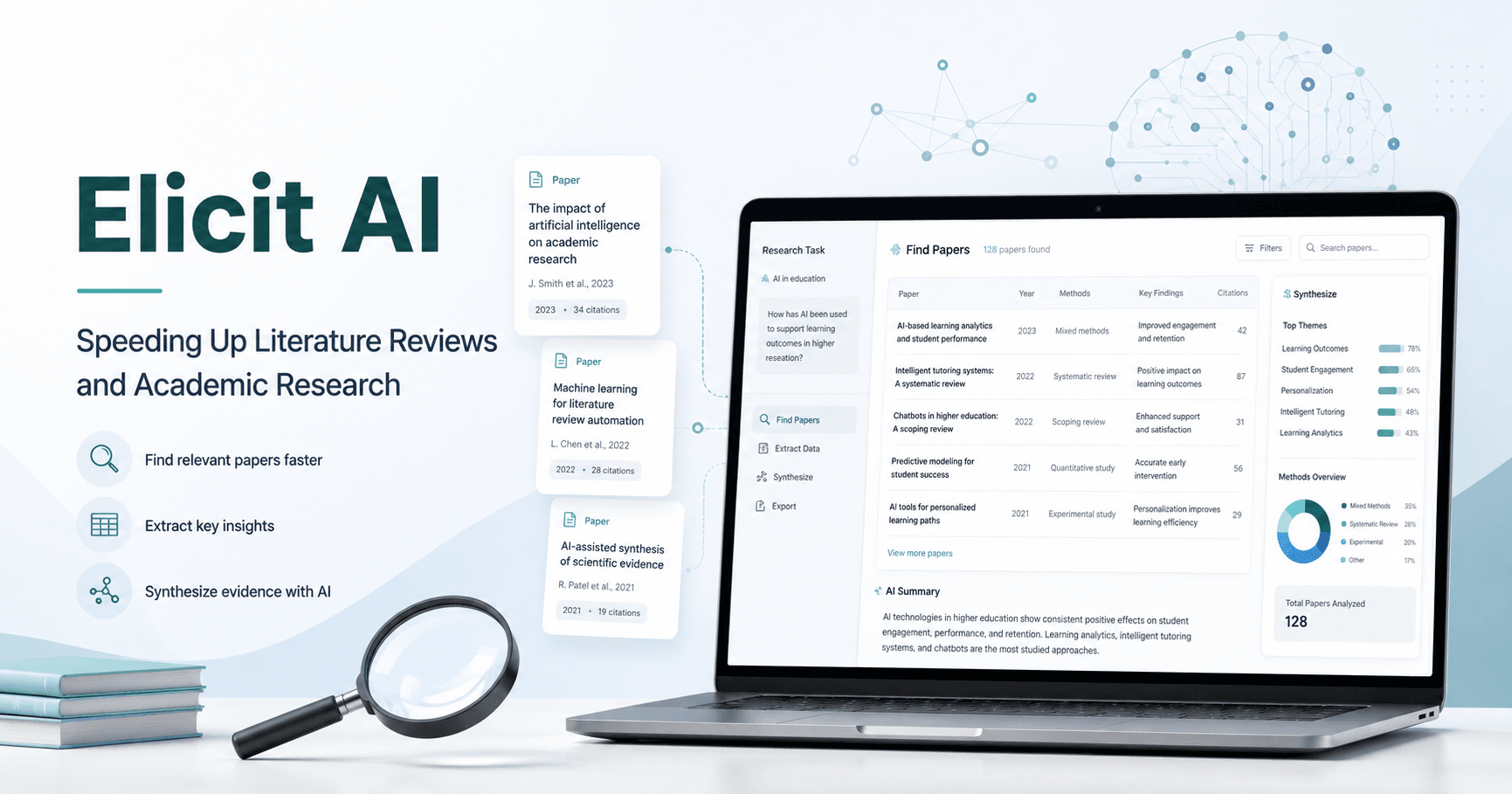

Artificial intelligence tools are changing the way people study, research, and understand scientific literature. Among these tools, Elicit AI has become one of the most useful platforms for students, researchers, and professionals who need to work with academic papers.
Elicit started as a simple tool for finding scientific papers through semantic search. Instead of searching only by exact keywords, it helps users ask research questions and find studies that are actually related to the topic. Over time, the platform has evolved into a much more complete research assistant, offering features for research reports, systematic reviews, paper summaries, data extraction, and even direct chat with academic papers.
What Is Elicit AI?
Elicit AI is a research assistant built to help users explore scientific literature faster. It can search across millions of papers, summarize findings, organize information into tables, extract useful data, and help researchers understand complex academic topics with less manual work.
For anyone who has ever tried to read dozens or hundreds of papers, this can be a major time saver. A traditional literature review can take days, weeks, or even months depending on the size of the topic. Elicit does not remove the need for human judgment, but it makes the process much easier to manage.
The platform is especially useful for people who need to answer research questions, compare studies, check evidence, or prepare a structured academic review.
Finding Papers With Elicit
One of the most basic and useful features of Elicit is the ability to find papers based on a research question.
For example, a user can ask something like:
What is the effectiveness of mindfulness-based interventions on reducing anxiety in university students?
After that, Elicit searches for relevant academic papers and presents a summary of the top results. Instead of giving only a list of links, it organizes the information in a table, showing each paper and important details about it.
This is useful because it gives the researcher a quick overview of the field. Instead of opening every paper manually, the user can first understand which studies are most relevant and what the general evidence seems to suggest.
Elicit also allows users to add custom columns to the table. For example, someone can ask it to show study limitations, sample size, intervention type, outcomes, or other specific details. This makes it easier to compare papers side by side.
Generating Research Reports
Another powerful feature is the ability to generate research reports.
In this workflow, the user enters a research question, and Elicit searches for papers, screens them, extracts data, and creates a structured report. The platform can offer different levels of depth depending on what the user needs. A faster report may analyze fewer papers and provide a quicker overview, while a more comprehensive report can go deeper into the literature.
This feature is helpful when someone needs to quickly understand a topic before writing an article, preparing a presentation, planning a study, or deciding whether a research question is worth exploring further.
The report usually includes summaries, extracted data, conclusions, and references. This gives the user a strong starting point, especially when working with unfamiliar academic fields.
Systematic Reviews With Elicit
One of the most impressive parts of Elicit is its systematic review workflow.
A systematic review is a structured method for analyzing all available research on a specific question. It normally involves searching for studies, defining inclusion and exclusion criteria, screening papers, extracting data, analyzing results, and reporting the findings clearly.
This process can be very time-consuming. In the transcript, the tool analyzes hundreds of papers and helps decide which ones should be included or excluded based on the research question and selected criteria.
Elicit can suggest screening columns, evaluate papers, assign inclusion scores, and help the user adjust the threshold for which papers should be included in the review. For example, papers with a higher inclusion score are more closely related to the research question, while papers with lower scores may be excluded.
This does not mean the AI should make the final academic decision alone. The researcher still needs to review the results carefully. But as a first pass, this can save a huge amount of time.
Data Extraction From Papers
After screening the papers, Elicit can extract important data from the selected studies.
This may include information such as:
Study design
Participant demographics
Intervention duration
Randomization details
Main outcomes
Effect size
Control group comparison
Limitations
This is one of the most valuable features for researchers because data extraction is often one of the slowest parts of a literature review. Normally, a person would need to open each paper, read the methods and results, and manually copy relevant information into a spreadsheet.
With Elicit, much of that structure can be created automatically. The user can also add custom columns depending on what they want to analyze.
Chatting With Papers
Elicit also allows users to chat with papers. This means the user can upload or select papers and ask questions about them.
For example, someone can ask:
What are the main findings from this paper?
What are the limitations?
What methods did the authors use?
What evidence supports the conclusion?
This is helpful when reading dense academic papers. Instead of spending a long time trying to understand every section, the user can ask targeted questions and use the answers as a guide.
The important point is that Elicit provides references to the parts of the paper it is using. This makes the experience more trustworthy than a generic AI chatbot that simply gives an answer without showing where the information came from.
Why Elicit Is Useful For Researchers
Elicit is useful because it helps reduce the repetitive parts of academic research. Searching, organizing, screening, summarizing, and extracting data are necessary steps, but they can take a lot of time.
With Elicit, researchers can move faster through the early stages of a project. They can understand a topic more quickly, identify important papers, compare findings, and build a clearer view of the literature.
For students, it can be a strong tool for essays, dissertations, theses, and research proposals. For professional researchers, it can support systematic reviews, grant writing, and evidence mapping.
It is also useful for people outside academia who need to understand scientific evidence, such as healthcare professionals, educators, analysts, and policy researchers.
Important Limitations
Even though Elicit is powerful, it should not be used blindly.
AI tools can make mistakes. They can misinterpret papers, miss important context, or extract information incorrectly. Because of that, the user should always check the original sources before making conclusions.
Elicit should be seen as a research assistant, not a replacement for critical thinking. It helps organize and accelerate the work, but the final responsibility still belongs to the researcher.
This is especially important in systematic reviews, where accuracy and transparency matter a lot. The AI can help with screening and extraction, but the researcher should verify the criteria, review included papers, and check whether the final report is reliable.
Is Elicit Worth Using?
For anyone who works with academic papers, Elicit is definitely worth testing.
The free version already offers useful features, such as searching across millions of papers, summarizing a limited number of papers, chatting with papers, and uploading PDFs. Paid plans unlock more advanced workflows, including larger extractions and systematic review features.
The best use of Elicit is not to let it do everything alone. The best use is to combine the speed of AI with human judgment. The tool can quickly show what the literature says, but the researcher should still check the evidence and decide what is valid.
Final Thoughts
Elicit AI is becoming one of the strongest tools for academic research. It helps users find papers, generate research reports, run systematic review workflows, extract data, and chat with scientific articles.
The biggest advantage is time. Tasks that could take hours or days can be organized much faster. This makes it easier to explore a research field, understand existing evidence, and start writing with more confidence.
For students, researchers, and professionals who need to deal with scientific literature, Elicit can be a powerful assistant. It does not replace careful reading or expert analysis, but it makes the research process more efficient, structured, and accessible.



Comments0
Please sign in to leave a comment.