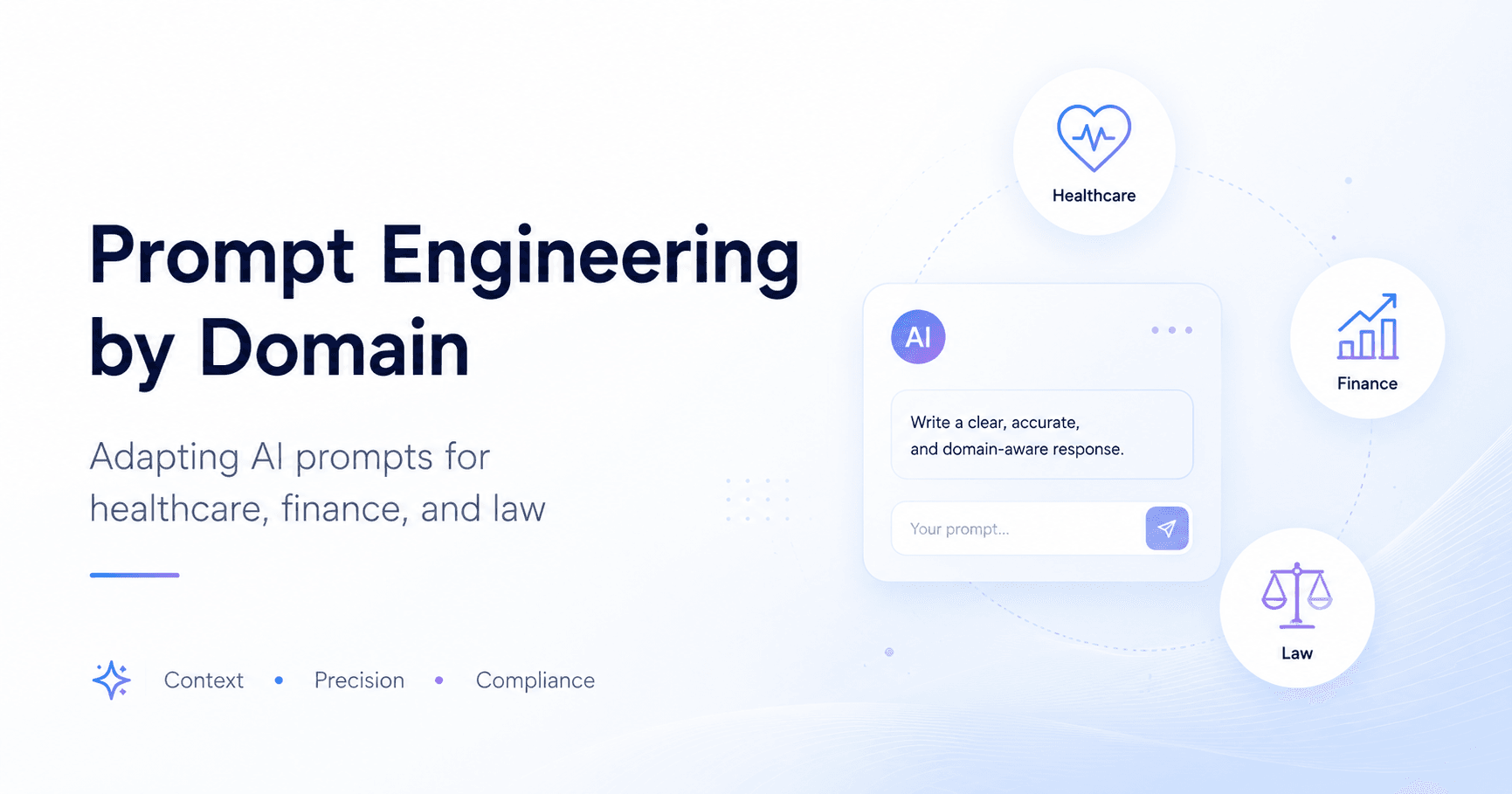

Prompt engineering changes a lot depending on the domain where it is applied. A prompt used for marketing should not have the same structure as a prompt used in healthcare, finance, or law.
Each area has its own vocabulary, rules, risks, compliance standards, and specific needs. That is why professional prompts need to be adapted to the context.
What is domain adaptation?
Domain adaptation is the process of customizing prompts for a specific area.
This means using the language, terminology, and conceptual structures of that sector. A generic prompt may work for a simple task, but in professional environments it can generate incomplete or inappropriate responses.
Domain adaptation involves four main principles:
• Contextual specificity
• Terminological precision
• Regulatory and ethical awareness
• Output structure and formatting
Contextual specificity
The prompt needs to provide enough information about the scenario.
For example, when asking for a financial analysis, include the type of company, sector, analyzed period, and goal of the analysis.
In healthcare, include the type of document, clinical context, and restrictions. In law, include the jurisdiction, legal area, and type of document.
The more specific the context, the more relevant the response tends to be.
Terminological precision
Each domain has its own terms. In healthcare, medical terms must be used correctly. In finance, accounting expressions and financial instruments must be handled precisely. In law, legal terminology must respect proper concepts and formats.
A terminology error can completely change the meaning of the response.
Regulatory and ethical awareness
Professional fields usually involve compliance rules.
In healthcare, there is concern about patient confidentiality and guidelines such as HIPAA. In finance, there are regulatory, risk, and security requirements. In law, there is professional responsibility, legal accuracy, and limits of use.
Prompts in these domains should include clear restrictions to avoid dangerous or inappropriate responses.
Output formatting and structure
In professional environments, the format of the response matters a lot.
You can ask for:
• Executive summary
• Risk list
• Structured document
• Preliminary opinion
• Checklist
• Comparative table
• Report with specific sections
Defining the structure helps the model deliver something more useful and easier to review.
Prompt engineering for healthcare
In healthcare, prompt engineering helps obtain more accurate responses in clinical, administrative, and medical research tasks.
Prompts must respect patient confidentiality and use medical terminology correctly.
Common applications include:
• Clinical record summaries
• Support for medical documentation
• Medical research
• Symptom analysis
• Organization of clinical information
• Assisted interpretation of images, with human supervision
AI can help, but it should not replace healthcare professionals. Its use must always consider safety, privacy, and expert validation.
Prompt engineering for finance
In finance, prompts need to deal with numerical data, risk, compliance, and time-sensitive decisions.
Applications include:
• Financial analysis
• Risk assessment
• Investment reports
• Customer service
• Analysis automation
• Security and compliance
Financial prompts should request clarity about assumptions, sources, data period, and analysis limitations.
It is also important to guide the model not to invent numbers and to state when additional data is needed.
Prompt engineering for law
In the legal sector, prompt engineering must be extremely careful.
It can support tasks such as:
• Document analysis
• Case law research
• Contract summaries
• Compliance verification
• Argument organization
• Support for legal discovery
Legal prompts should consider jurisdiction, document type, citation standard, and appropriate legal terminology.
Generated content must be treated as support, not as a final decision. Human review is indispensable.
Model parameters
In addition to the prompt text, many models allow configuration of parameters that influence the output.
These parameters can be used through APIs or advanced interfaces. Ideally, you should adjust one parameter at a time, because results may vary between models.
Not all parameters are available in all LLMs.
Determinism parameters
These parameters control the level of predictability or creativity.
Temperature controls randomness. Low values generate more objective and consistent responses. High values generate more varied and creative responses.
Top_p limits the selection of possible words based on cumulative probability.
Top_k limits the choice to a specific number of the most likely options.
Lower values tend to produce more factual responses. Higher values tend to generate more diversity.
Token count
Tokens are text units used by the model to process input and output.
The maximum token parameter controls the length of the response. This is useful for limiting summaries, short answers, or generating longer texts.
Stop sequences
Stop sequences tell the model when it should stop generating text.
This is useful to avoid responses that are too long or to interrupt the output when a specific marker appears.
Number of results
Some models allow generating more than one response for the same prompt.
This is useful when you want to compare alternatives, such as titles, descriptions, ideas, or creative versions.
Penalties
Penalties help reduce repetition.
Frequency penalty reduces the repetition of words or phrases already used. Presence penalty encourages the model to introduce new topics. Some models also have specific penalties, such as count penalty.
Conclusion
Professional prompt engineering requires domain adaptation and an understanding of model parameters.
In healthcare, the focus is safety and confidentiality. In finance, precision and compliance. In law, terminology, jurisdiction, and responsibility.
In addition, parameters such as temperature, tokens, top_p, top_k, stop sequences, and penalties help control model behavior.
A good prompt is not just well written. It is appropriate for the domain, the risk, and the expected result.
References: https://skillbuilder.aws/learn/VF6H4SZ1BU/foundations-of-prompt-engineering/






Comments0
Please sign in to leave a comment.