
Artificial intelligence is no longer just a race between technology companies. It has become a matter of national security.
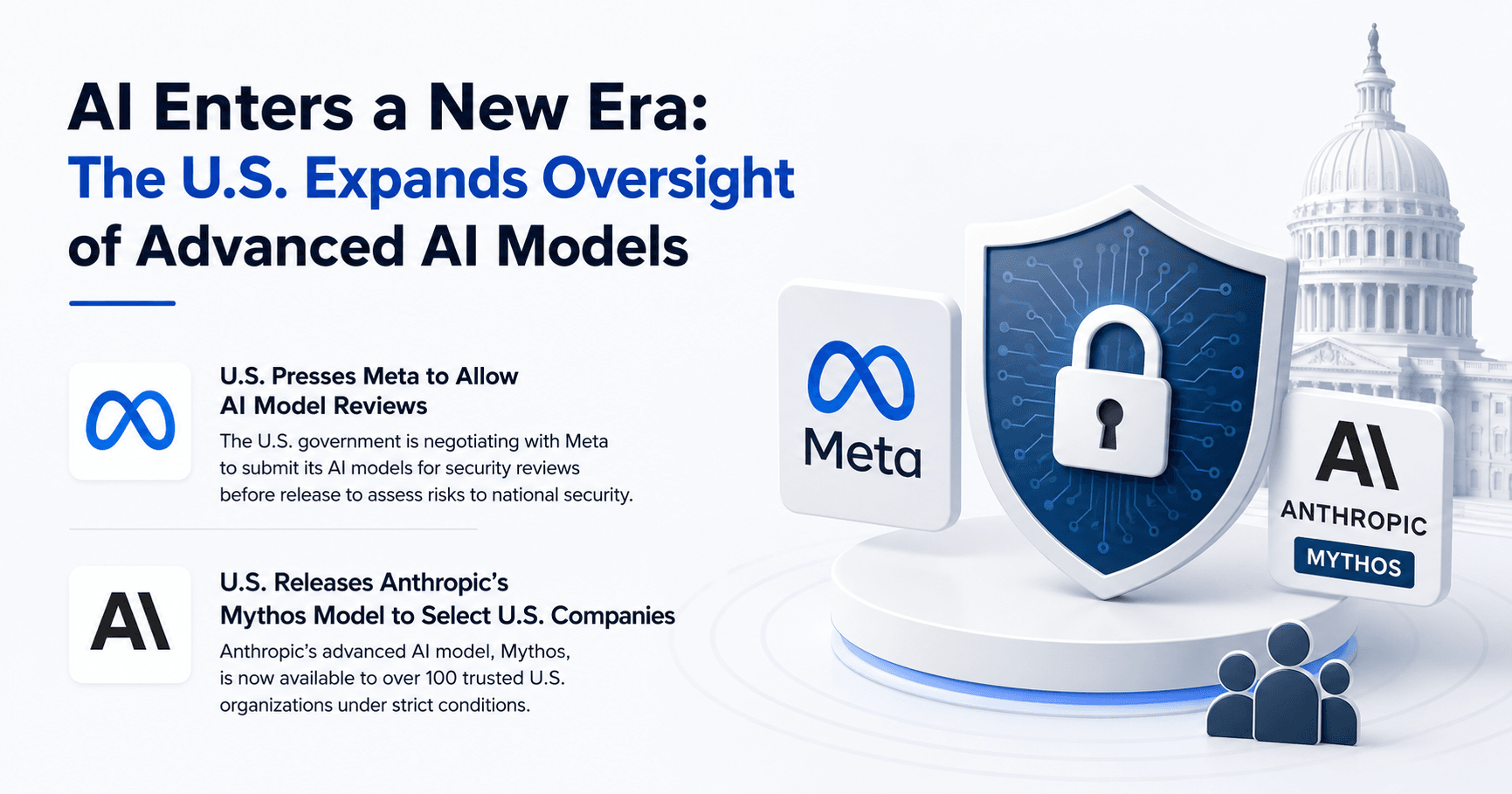
Over the past few weeks, two major developments have highlighted this shift. While the U.S. government is pushing Meta to allow official reviews of its AI models before release, Anthropic has received approval to make its powerful Mythos model available only to a limited group of trusted organizations.
Together, these events suggest that the next generation of AI models may undergo security reviews similar to those required for other strategic technologies before reaching the public.
The U.S. Wants to Review Meta's AI Models
According to Reuters, the U.S. government is working with Meta to voluntarily submit its AI models for security evaluations before they are released.
The goal is to allow government experts to assess the models' capabilities, potential vulnerabilities, and any risks related to national security.
Companies such as OpenAI, Anthropic, Google, Microsoft, and xAI already participate in this voluntary pre-release review program. Meta is one of the few major AI companies still finalizing the agreement.
Government interest has grown as AI models have rapidly improved, particularly in software development, vulnerability discovery, and the automation of complex technical tasks.
The Anthropic Mythos Case
Just a few days later, another Reuters report reinforced this growing trend.
The U.S. government authorized Anthropic to provide access to its Mythos model to more than 100 U.S. organizations, including companies responsible for critical infrastructure and selected government agencies.
However, access remains highly restricted.
Mythos drew significant attention because of its advanced cybersecurity capabilities. During controlled testing, the model reportedly identified vulnerabilities in highly sensitive systems within hours, demonstrating performance well beyond what is typically expected from today's AI systems.
Because of these capabilities, the government initially limited its distribution while evaluating the potential security risks.
Security Is Becoming a Top Priority
Until recently, the AI race was largely about building faster and more capable models.
Now, another factor has become just as important: security.
Governments are increasingly concerned that advanced AI models could be used to:
Discover critical software vulnerabilities.
Automate sophisticated cyberattacks.
Support military or intelligence operations.
Develop offensive cyber capabilities at scale.
At the same time, these very capabilities can also strengthen cybersecurity by helping organizations detect weaknesses before attackers do and improve the protection of critical infrastructure.
The challenge is finding the right balance between innovation and security.
A Trend That Is Likely to Grow
These recent developments suggest that government oversight of advanced AI models will likely become more common.
As AI continues to evolve, governments around the world are beginning to treat frontier AI systems as strategic technologies, similar to those used in defense, energy, and telecommunications.
This does not necessarily mean stricter controls for every AI model, but frontier models with exceptional capabilities will likely face additional security evaluations before wider deployment.
Conclusion
The recent developments involving Meta and Anthropic signal that the AI industry is entering a new phase.
The conversation is no longer only about which company builds the most powerful model, but also about who can develop and deploy these systems safely and responsibly.
Over the coming years, innovation, regulation, and security are expected to evolve together, shaping how the next generation of artificial intelligence is developed and released to the world.



Comments0
Please sign in to leave a comment.