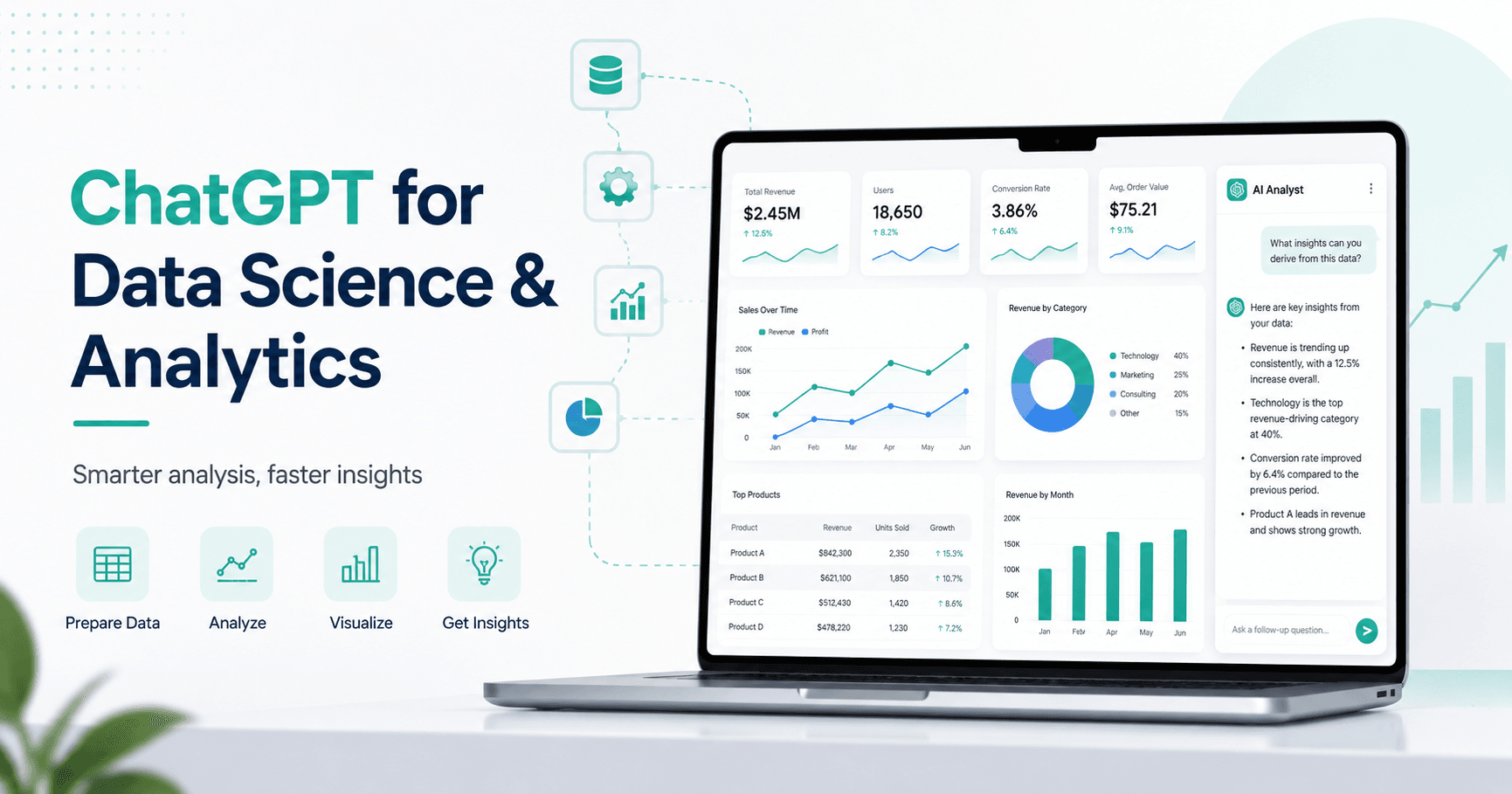

Data science has become an essential part of modern companies. Today, almost every organization needs to understand its data to make better decisions, find opportunities, reduce costs, and improve its products.
The problem is that many teams still spend too much time on repetitive tasks: organizing files, reviewing spreadsheets, transforming data, creating reports, building dashboards, and explaining results to other areas of the company.
This is where ChatGPT can help.
The idea behind ChatGPT for data science and analytics is to turn business questions into clearer, faster, and more actionable analyses. Instead of relying only on manual processes, teams can use AI to speed up important parts of data work, from preparation to communicating results.
Turning Questions into Real Analysis
One of ChatGPT’s biggest advantages is helping organize ideas that are still unclear.
Imagine a marketing team wants to understand why conversions dropped in some regions. Usually, this question needs to become an analysis plan: which metrics will be evaluated, which data sources will be used, which hypotheses will be tested, and what the project timeline will be.
With ChatGPT, this initial question can become a more structured roadmap.
For example, AI can help define:
Main metric, such as new paid users by region.
Supporting metrics, such as conversion rate, acquisition cost by channel, and activation rate.
Data sources, such as CRM, product data, ad campaign data, and financial systems.
Analysis steps, organized by week or priority.
This does not eliminate the role of the analyst. On the contrary, it helps the professional start faster and with more clarity.
Support for Creating Data Pipelines
Another important use is data preparation.
In data science projects, a large part of the work happens before the model is trained. It is necessary to clean data, create variables, validate information, combine tables, and make sure everything is consistent.
ChatGPT can help generate pipeline ideas, create SQL logic, suggest validations, and organize data quality rules.
For example, a team can send a user event schema and ask AI to suggest transformations. ChatGPT can help create useful columns, apply normalizations, calculate moving averages, identify missing values, and propose tests to prevent errors.
This makes the process more agile and reduces the risk of forgetting important steps.
Model Monitoring and Drift Detection
Creating a machine learning model is not the end of the work. After it goes into production, it is necessary to monitor whether it continues to perform well.
Over time, user behavior changes, data changes, and the model may lose accuracy. This problem is known as drift, or model drift.
ChatGPT can help summarize drift reports, compare recent data with older data, and explain possible causes of performance drops.
For example, if a conversion prediction model starts making more mistakes, AI can help investigate changes in variables such as session duration, device used, traffic source, or behavior inside the app.
This allows the team to act earlier, fix problems, and keep predictions more reliable.
Creating Dashboards and Executive Reports
The challenge is not always analyzing the data. Often, the biggest problem is explaining the results in a simple way to the people who need to make decisions.
ChatGPT can turn technical analyses into executive summaries, dashboard storyboards, and clearer presentations.
A team can share revenue, retention, churn, or campaign results and ask AI to organize everything into a visual narrative.
For example, ChatGPT can suggest sections such as:
Growth by region.
Customer retention.
Churn risks.
Main KPIs.
Important alerts.
Recommended next actions.
This helps transform raw data into useful information for managers, leaders, and business teams.
A More Integrated Workspace
The official page also highlights the idea of a unified workspace.
This means bringing analysts, data scientists, data engineers, and decision-makers together in an environment where everyone can collaborate better.
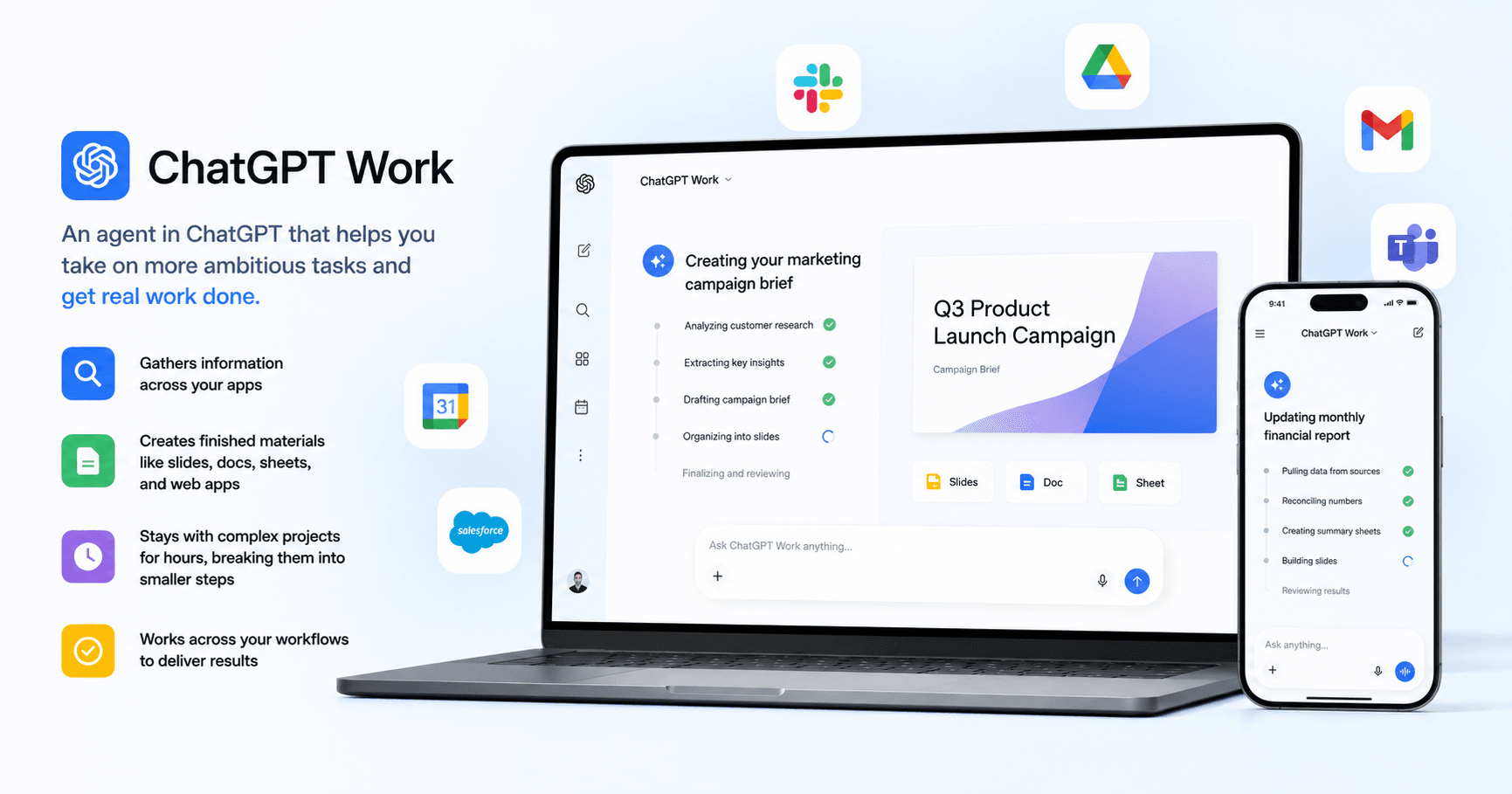
Instead of working with information spread across many tools, the team can use ChatGPT connected to files, spreadsheets, internal systems, BI apps, and company knowledge bases.
In practice, this helps reduce rework, speed up research, and improve communication between technical and non-technical teams.
More Productivity for Data Teams
ChatGPT does not replace the technical knowledge of a good data professional. But it can save time in many parts of the process.
It can help with:
Creating analysis plans.
Summarizing documents and reports.
Generating initial SQL queries.
Reviewing formulas and spreadsheets.
Explaining model results.
Creating dashboard ideas.
Organizing metrics and KPIs.
Writing technical documentation.
Preparing executive presentations.
Creating data quality tests.
With this, teams can spend more time on what really matters: interpreting results, validating hypotheses, and making better decisions.
Data Security and Privacy
When we talk about business data, security is an essential concern.
ChatGPT Business includes features designed for companies, such as user controls, secure authentication, and dedicated workspaces. The official page also highlights that, by default, company data is not used to train the models.
This is important because data teams usually work with sensitive information, such as financial metrics, customer data, internal models, and business strategies.
Having a safer environment allows AI to be used more reliably within the organization.
Practical Use Examples
A data team can use ChatGPT for many everyday tasks.
For example, it can ask ChatGPT to create an A/B test plan with a main metric, sample size, randomization, and stopping rules.
It can also request a model interpretability report, including analysis of important variables, subgroups, and possible biases.
Another possibility is asking for an anomaly detection plan, with triage rules and alerts to identify problems before they affect the business.
These examples show that ChatGPT can work as a strategic assistant, helping structure the work and speed up deliveries.
Conclusion
ChatGPT can be a powerful tool for data science and analytics because it helps transform data into decisions.
It can support everything from simple tasks, such as summarizing a spreadsheet, to more advanced activities, such as creating pipelines, analyzing model drift, structuring dashboards, and generating executive reports.
The most important thing is to understand that AI does not replace the analyst, data scientist, or data engineer. It works as a work partner.
When used well, it helps teams save time, better organize information, and deliver insights with more speed and clarity.
For companies that work with data every day, this combination of artificial intelligence, business context, and human analysis can become a major competitive advantage.

Comments0
Please sign in to leave a comment.