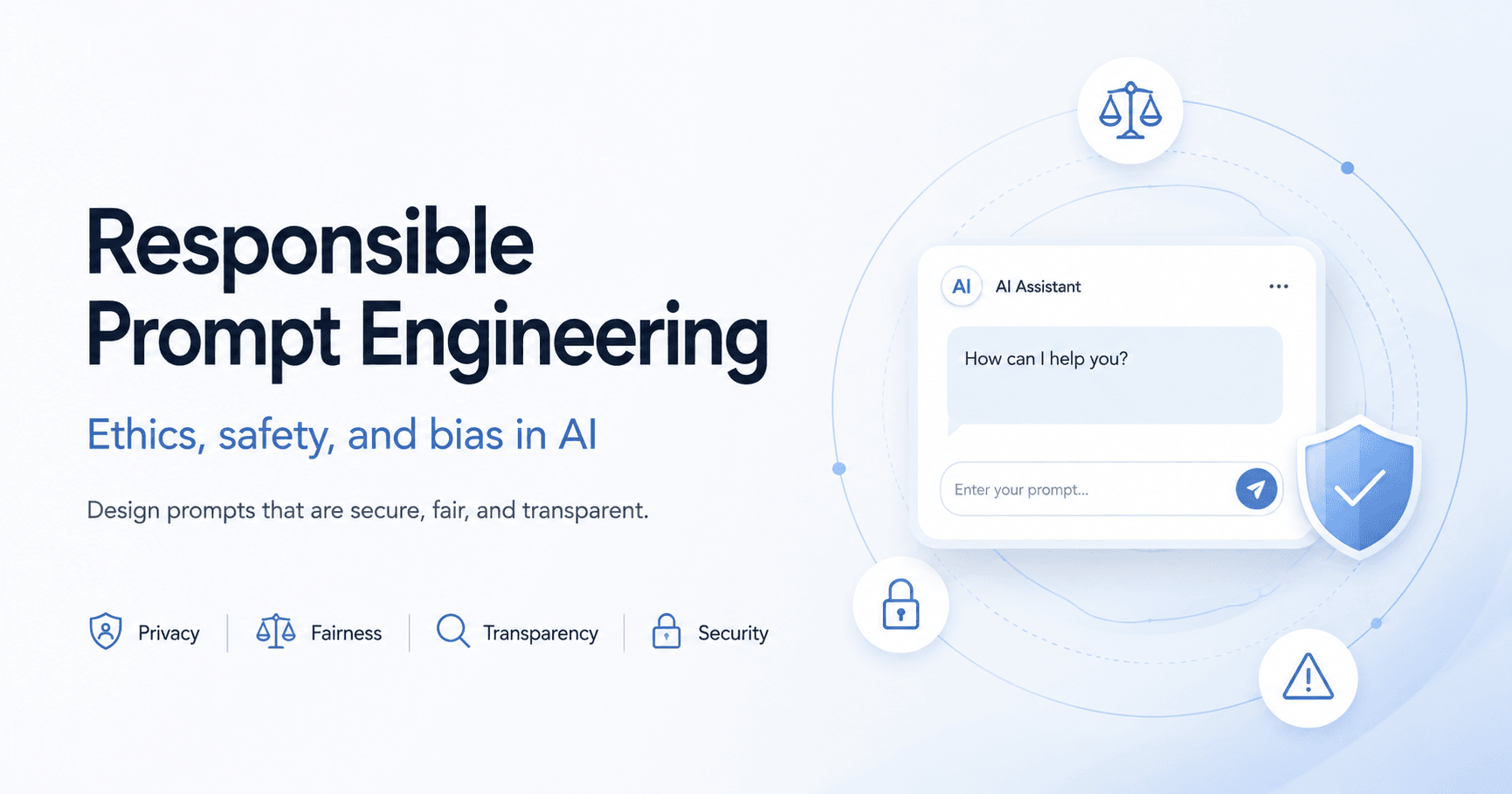

Prompt engineering is not only about creating better instructions. It also requires responsibility.
The way a prompt is written can influence responses, decisions, behaviors, and even social impacts. That is why understanding risks, misuse, ethics, and bias is essential for anyone working with AI.
Adversarial prompts
Adversarial prompts are instructions created to deceive, manipulate, or exploit AI models.
They can be used to try to make the model ignore rules, reveal private information, generate harmful content, or produce responses outside its expected behavior.
Two important risks are:
• Prompt injection
• Prompt leakage
What is prompt injection?
Prompt injection is a technique used to influence the model’s output through malicious or manipulative instructions inside the prompt.
An attacker may try to make the model generate harmful, unethical, biased, or misleading content.
This type of attack can be used to create fake news, propaganda, scams, spam, or malicious content at scale.
But prompt injection can also be used in non-malicious contexts, such as customizing translations, preserving product names, or replacing response patterns.
The problem lies in misuse and lack of control.
How to reduce prompt injection risks
To reduce risks, it is important to:
• Define clear system rules
• Separate user data from system instructions
• Validate suspicious inputs
• Limit automated actions
• Monitor responses
• Test prompts against manipulation attempts
AI should be treated as a system that can be exploited if there is no protection.
What is prompt leakage?
Prompt leakage is the risk of an AI system revealing sensitive or private information through the responses it generates.
This can happen if the system was trained on or supplied with confidential data, such as customer information, browsing history, purchases, internal documents, or personal data.
For example, an AI used for recommendations may end up revealing details about previous customers’ purchases. This compromises privacy, security, and trust.
How to reduce information leakage
Some good practices include:
• Do not insert sensitive data unless necessary
• Remove personal information from prompts
• Use anonymization
• Control access to internal databases
• Limit what the model can retrieve
• Review responses before public use
• Apply security and privacy policies
Data protection should be part of the project from the beginning.
Ethics in AI
AI ethics involves principles for developing and using artificial intelligence in a fair, responsible, and safe way.
In prompt engineering, this is important because prompts guide AI responses. A prompt can lead the model to generate useful responses, but it can also induce manipulation, bias, or misinformation.
Ethical foundations
Fairness seeks to avoid discrimination and promote inclusion. AI systems should benefit different groups fairly.
Transparency and explainability help users and stakeholders understand how the system works, what its limitations are, and how it should be used.
Privacy and data protection ensure that personal information is handled carefully.
Responsibility and governance define who is accountable for the system’s use, how it is monitored, and what controls exist.
Ethical implications of prompts
Prompts can be used to make responses more persuasive or manipulative. This raises concerns about autonomy and informed consent.
They can also amplify existing biases. If a prompt reinforces stereotypes, AI may generate discriminatory responses.
Another concern is misrepresentation. AI can be used to create content that appears human, true, or trustworthy but is misleading.
There is also the issue of power dynamics and access. Not everyone has the same level of access or ability to use AI, which can increase inequalities.
Ethical guidelines for prompt design
Safety should be considered from the beginning.
This means testing prompts before deployment, identifying biases, anticipating possible harms, and documenting limitations.
Good practices include:
• Create prompts with transparency
• Document design choices
• Inform users about AI capabilities and limitations
• Regularly monitor results
• Update prompts when necessary
• Create feedback channels
• Review risks before large-scale use
Ethics should not be a final detail. It needs to be part of the process.
Case studies and real risks
A resume tool may seem useful, but if it exaggerates achievements and adds skills the person does not have, it creates misleading information and harms employers and candidates.
A school assistant that generates assignments that look like human work can encourage academic dishonesty and harm real learning.
A review generator can be used to create thousands of fake comments, manipulating consumers and damaging trust in marketplaces.
A poorly tested mental health assistant can provide dangerous responses during moments of vulnerability, especially when users express risk of self-harm.
These examples show that poorly planned prompts can cause real harm.
Bias in models and prompts
Bias can appear in two ways.
The first is when the prompt itself contains assumptions. For example, a prompt that assumes all developers are men may generate biased responses.
The second is when the model generates biased responses even with a neutral prompt, because of the training data.
If the training data is limited or not diverse enough, the model may reproduce inequalities and stereotypes.
Lack of data also reduces the model’s confidence and can cause filters and classifiers to unfairly exclude groups.
How to mitigate bias
There are three main ways to reduce bias in foundation models.
The first is to update the prompt. Explicit instructions can guide the model to avoid stereotypes and consider diversity.
The second is to improve the dataset. This includes adding diverse examples, different pronouns, varied contexts, and broader representation.
The third is to use training techniques, such as fair loss functions, red teaming, and RLHF.
In text-to-image models, frameworks such as TIED and benchmarks such as TAB help evaluate and reduce ambiguities and biases.
Conclusion
Prompt engineering must balance efficiency, safety, and responsibility.
Prompts can improve productivity, but they can also be used to manipulate, leak data, reinforce prejudice, or generate misinformation.
That is why good prompt engineers need to think beyond the immediate response. It is necessary to consider privacy, fairness, transparency, governance, and social impact.
AI is powerful, but its responsible use depends on the human choices behind the prompts.
References: https://skillbuilder.aws/learn/VF6H4SZ1BU/foundations-of-prompt-engineering/




Комментарии0
Пожалуйста, войдите, чтобы оставить комментарий.