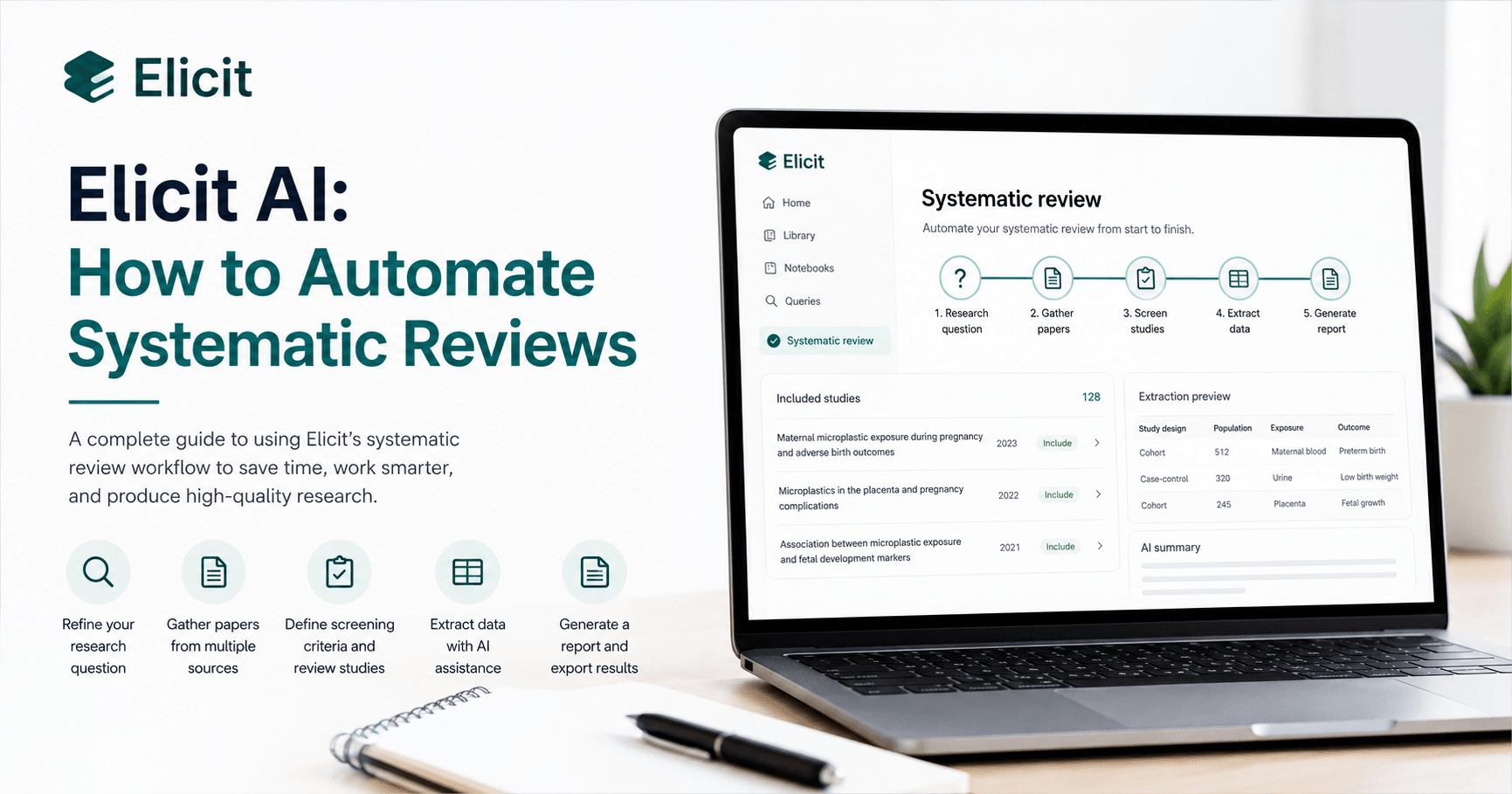

Systematic reviews are one of the most important and time-consuming tasks in academic research. They help researchers understand the current state of science on a specific topic, compare evidence, identify patterns, and support better decisions.
The problem is that a systematic review can take weeks or even months. Researchers need to define a strong research question, collect papers, screen studies, extract data, analyze findings, and write a structured report. Each step requires attention, accuracy, and transparency.
Elicit AI is trying to make this process faster and more organized. Its systematic review workflow helps researchers automate many repetitive parts of the review while still keeping human control over the final decisions.
What Is Elicit AI?
Elicit AI is an artificial intelligence research assistant built for academic work. It helps users search scientific papers, summarize studies, extract information, and organize evidence.
Its systematic review workflow goes further. Instead of only helping users find papers, Elicit now supports several major steps of a systematic review, including research question refinement, paper gathering, screening, data extraction, report generation, sharing, and exporting.
The goal is not to replace researchers. The goal is to save time so they can focus more on critical thinking, interpreting results, and making better evidence-based decisions.
Starting With a Better Research Question
A good systematic review starts with a clear research question.
In Elicit, the user begins by entering a question or even a broad topic. For example, someone might start with something vague like “microplastics and pregnancy.”
Instead of immediately running the review, Elicit gives feedback on the research question. It suggests ways to make the question more specific, such as defining the population, exposure, comparison, or outcome.
For example, it may suggest a more focused question like:
What is the association between maternal exposure to microplastics during pregnancy and adverse birth outcomes?
This step is important because the research question controls everything that happens later. If the question is too vague, the search, screening, extraction, and final report may become less useful. By helping users refine the question early, Elicit makes the process more structured from the beginning.
Gathering Papers From Different Sources
After defining the research question, Elicit helps gather papers for the review.
Users can bring papers from different sources. They can use Elicit Search, upload their own PDFs, or select papers from their Elicit Library. Elicit Search uses semantic search, which means it looks for papers based on meaning, not just exact keywords.
This is useful because traditional academic search often depends on Boolean search strings and exact terms. Those methods are still important, especially for formal systematic reviews, but they can miss relevant papers when the wording is different.
Elicit can search across a large academic database and suggest papers that are semantically related to the research question. Users can add hundreds of papers at once, then screen them later.
For formal academic or regulatory work, Elicit can also be used as a supplement to traditional search methods. Researchers can still run their normal database searches, then bring those papers into Elicit and use the AI search as an extra layer to avoid missing relevant studies.
Defining Screening Criteria
Once the papers are gathered, the next step is screening.
Screening means deciding which papers should be included or excluded from the review. This is usually based on specific criteria, such as population, study type, intervention, outcome, or measurement method.
Elicit can automatically suggest screening criteria based on the research question. These criteria are not generic. They are customized to the specific review.
For example, in a review about microplastics and pregnancy, Elicit might suggest criteria such as whether the study includes pregnant women, measures direct maternal exposure, reports at least one birth outcome, or was conducted in humans rather than animals.
The user can accept, edit, remove, or add criteria manually. This is important because the researcher still controls the review protocol. The AI provides a first draft, but the human decides what matters.
Iterating Before Running the Full Screening
One smart part of Elicit’s workflow is that it starts with a sample of papers before applying the criteria to the full set.
Instead of screening all papers immediately, Elicit first shows a smaller sample. This allows the researcher to test the screening criteria and see whether they work well.
This matters because researchers often realize that their criteria are too strict, too broad, or missing something after they see real examples from the literature.
In a fully manual workflow, changing criteria after starting can be slow and expensive. In Elicit, the process becomes more flexible. Users can adjust the criteria, review the sample again, and only then run the screening across the full paper set.
Evaluating Screening Results
After the screening criteria are ready, Elicit applies them to the full set of papers.
The papers are ranked based on how likely they are to be included. The most relevant papers appear at the top, while less relevant papers appear lower in the list.
For each paper, Elicit explains why it recommends including or excluding it. It also shows how each paper performs against each screening criterion.
This transparency is one of the strongest parts of the workflow. The user can see not only the final recommendation, but also the reasoning behind it.
If the researcher disagrees with the AI, they can manually override the decision. This keeps the process controlled by the researcher, not the tool.
Extracting Data From Papers
After screening, the next step is data extraction.
This is one of the most time-consuming parts of systematic reviews. Researchers need to go through the included papers and collect specific information, such as study design, participant characteristics, outcome measures, intervention details, effect sizes, and limitations.
Elicit can suggest extraction fields automatically based on the research question. These fields can be edited, removed, or expanded by the user.
The tool can extract information from the paper text and even from tables. It also links AI-generated answers to quotes from the original paper, making it easier to check whether the extraction is accurate.
This is important because academic work needs traceability. Researchers cannot simply trust an AI answer without checking the source. Elicit keeps every extracted answer connected to the underlying evidence.
Generating a First Draft Report
Once the papers are screened and the data is extracted, Elicit can generate a first draft of a report.
This report is not meant to be a finished systematic review ready for publication. Instead, it works as a structured starting point.
The report can include a summary of the research question, an abstract-style overview, a methods section, screening information, extracted data, study summaries, discussion themes, and references.
This helps researchers understand the data from another angle. Instead of only looking at tables, they can read a narrative synthesis that highlights patterns across the literature.
Collaboration, Exporting, and Living Reviews
Elicit also supports sharing and exporting.
Users can download results from different stages of the workflow, such as screening results, extraction tables, and reports. This is useful for further analysis in spreadsheets or other research tools.
On team or enterprise plans, users can collaborate with others in real time. This allows multiple researchers to review, edit, and check the same systematic review workflow.
Another interesting idea is the possibility of living reviews. A traditional systematic review can become outdated by the time it is published because new papers continue to appear. With a digital AI-supported workflow, researchers may be able to update a review more easily by adding new papers and running them through the existing screening and extraction criteria.
Why Elicit Is Different
The biggest difference in Elicit’s approach is transparency.
Many AI tools give answers, but they do not always show where those answers came from. Elicit is designed for users who care about accuracy, scale, and evidence. It gives explanations, links answers to the source text, allows manual overrides, and lets researchers edit the workflow at different stages.
This makes it useful for power users who already understand systematic reviews and want to speed up the process without giving up control.
Elicit is not just a chatbot for research. It is closer to a structured research workspace where AI helps with repetitive tasks, while the researcher remains responsible for judgment and interpretation.
Final Thoughts
Elicit AI is becoming a powerful tool for systematic reviews. It can help researchers refine their questions, collect papers, define screening criteria, evaluate studies, extract data, generate draft reports, export results, and collaborate with teams.
Its biggest value is time savings. Tasks that usually take weeks can become much faster, especially screening and data extraction. But the tool is most useful when combined with human expertise.




Komentar0
Silakan masuk untuk meninggalkan komentar.