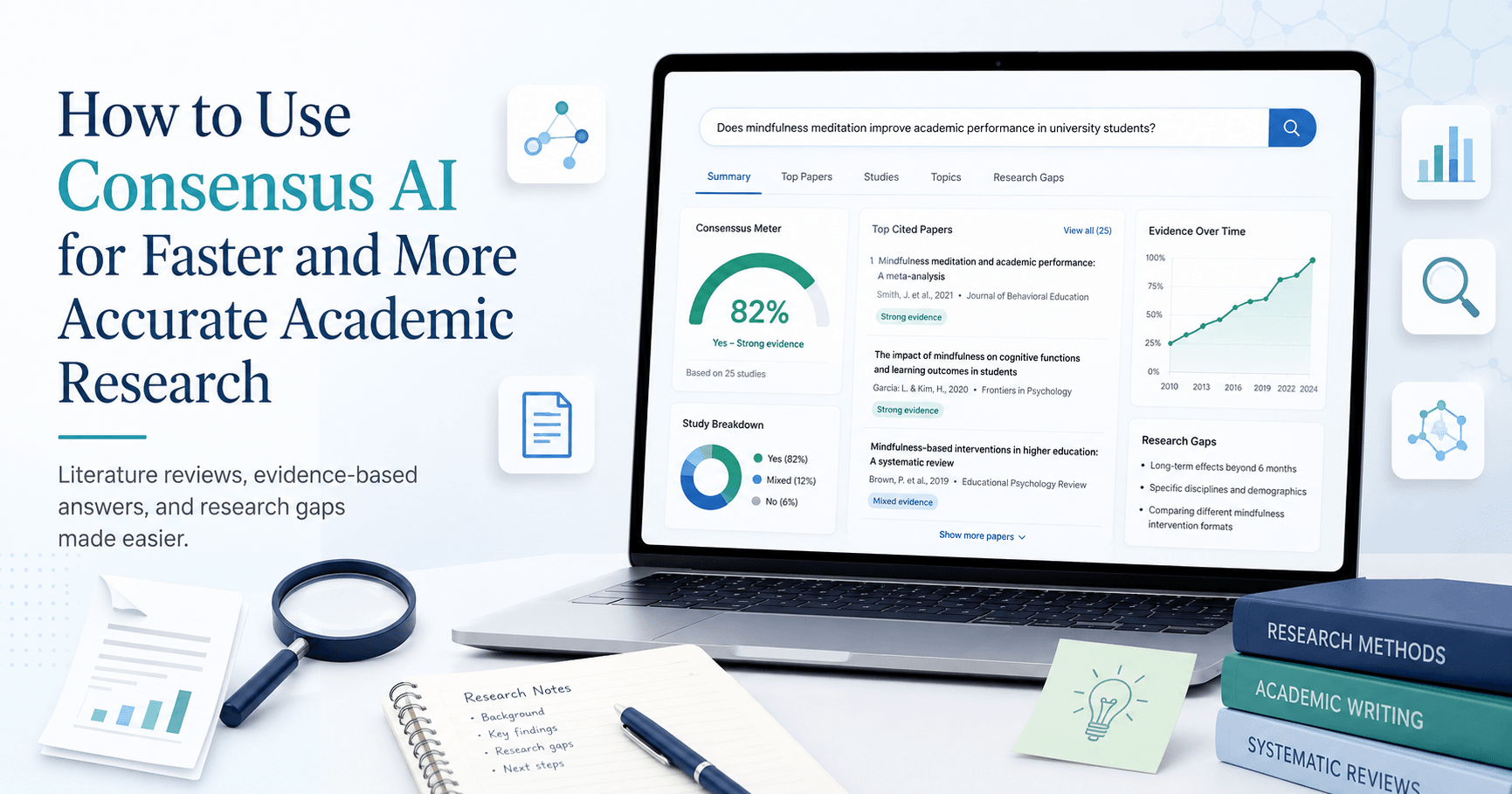

Consensus AI is an artificial intelligence tool designed for academic research, literature reviews, and scientific study analysis. Unlike a regular chatbot, it was created to answer questions based on scientific papers, showing sources, evidence, and even the level of agreement among the studies found.
For students, researchers, teachers, or anyone who needs to quickly understand what science says about a topic, Consensus can save many hours of manual reading.
What Is Consensus AI?
Consensus works like an academic search engine powered by AI. You ask a question, and it searches for answers in a large database of scientific papers. The platform can analyze millions of studies, organize the results, and present a clearer view of a specific topic.
One of its most interesting features is that it allows you to ask simple questions, including “yes or no” questions. For example: “Can turmeric help with weight loss?” or “Does physical exercise improve mental well-being?” From there, Consensus shows a summary of the evidence found.
First Step: Set Up Institutional Access
Before you start using the tool, an important recommendation is to check your account settings. If you have access through a university or institution, you can connect that access to Consensus.
This is very useful because it may unlock full-text papers that are normally restricted in academic databases. For serious research, this makes a big difference, since the abstract alone is often not enough for a deeper analysis.
How to Ask Good Questions in Consensus
One advantage of Consensus is that you do not need to create complex prompts. The tool works well with direct and simple questions.
For quick doubts, “yes or no” questions usually work very well. They help Consensus generate an objective answer and show the level of agreement among the studies.
Examples:
“Does physical exercise improve mental health?”
“Do probiotics help with irritable bowel syndrome?”
“Can turmeric contribute to weight loss?”
For finding literature on a topic, broader questions are usually better, such as:
“What are the best materials for increasing strength in nanomaterials?”
“What are the main advances in OPV devices?”
“What are the effects of physical exercise on mental well-being?”
Understanding the Search Modes
Consensus offers different levels of analysis depending on how much depth you need.
Quick Search is ideal for simple questions. It analyzes a smaller number of papers and delivers an objective answer. It is a good option when you only want to quickly understand what the literature says about a specific topic.
Pro Search goes deeper. It analyzes more sources, brings more complete summaries, lists of papers, important insights, and comparative tables. It is a good choice for anyone starting a research project or trying to map a subject more clearly.
Deep Search is better suited for literature reviews. It analyzes a larger number of sources and delivers a more detailed view, including a results timeline, evidence tables, key authors, research gaps, and open questions.
What Is the Consensus Meter?
One of the most useful features of the tool is the Consensus Meter. It visually shows how much the studies found agree or disagree about a question.
For example, if you ask whether a certain supplement helps with weight loss, Consensus may show that 80% of the studies say “yes,” while 20% present mixed results.
This does not replace critical reading of the papers, but it helps you get an initial view of the topic. Instead of relying on random opinions or marketing content, you can quickly see what the research indicates.
Using Filters to Improve Results
Another strong point of Consensus is its filters. They help reduce academic noise and find more relevant studies.
You can filter by publication year, choosing only recent studies from the last 5 or 10 years. You can also prioritize papers from higher-impact journals, such as Q1 journals, and filter by citations, methodology, field of study, country, and open access.
These filters matter because not every paper carries the same weight. A recent study published in a strong and well-cited journal may be more relevant than an older study with weaker methodology.
How to Find Scientific Literature
To find papers about a topic, the best approach is to use open-ended questions and choose a more complete search mode, such as Pro or Deep.
Imagine you want to research the best nanomaterials for strength. Consensus can bring a list of materials mentioned in the studies, such as graphene and graphene oxide, while also presenting tables with the main findings from the literature.
From there, you can explore the papers, open specific sources, ask questions about a paper, and deepen your research without having to start from scratch across multiple databases.
How to Find Research Gaps
One of the most powerful functions of Consensus is helping you find research gaps.
In the past, finding a gap required many hours of reading papers, comparing topics, identifying patterns, and noticing what had not yet been well explored. With Consensus, you can ask directly:
“What are some research gaps in the area of OPV devices?”
The tool can generate a research gap matrix, showing which topics already have many studies and which still have little investigation. This is extremely useful for anyone looking for a topic for an undergraduate thesis, dissertation, PhD thesis, or scientific article.
If an area appears with many studies, it may already be saturated. But if Consensus shows a clear gap, it can be an opportunity to develop original research.
Using Consensus for Literature Reviews
For literature reviews, Deep Search is the most recommended mode. It allows you to analyze a research field with more depth and organize the main results.
When asking, for example, whether physical exercise improves mental well-being, Consensus can provide a complete answer with an introduction, Consensus Meter, search methodology, included studies, evidence table, strength of evidence, results timeline, and research gaps.
This type of output helps a lot in the early stage of a review because it organizes the path forward. The researcher still needs to critically analyze the data, but the tool greatly reduces the repetitive work of searching and organizing information.
Creating Drafts and Text Structures
In addition to searching for papers, Consensus can also help create structures for literature reviews. You can ask for an outline on a specific topic, such as:
“Create an outline for a literature review on probiotics for irritable bowel syndrome.”
The tool can suggest sections, organize the main topics, and indicate related references. This makes it easier to create an initial structure for academic articles, college assignments, or more complete reviews.
Does Consensus Replace the Researcher?
No. Consensus does not replace human analysis. It helps find, summarize, and organize information, but it is still the researcher’s responsibility to interpret the studies, evaluate the quality of the sources, and build their own conclusion.
The main advantage is that it removes part of the mechanical work from the process. Instead of spending hours manually searching for papers, you can move faster to the truly important part: understanding, comparing, questioning, and creating new ideas.
Conclusion
Consensus AI is one of the most useful tools for anyone working with research, science, or academic writing. It helps answer questions based on evidence, find relevant papers, identify research gaps, and create structures for literature reviews.
For beginners, the best path is to start with simple questions and use the Consensus Meter to quickly understand what the studies say. Then, it is worth exploring Pro and Deep searches for more complete analysis.
In a world full of scattered information, opinions, and marketing, Consensus stands out by bringing answers based on scientific literature. For anyone who wants to study better, research more confidently, and save time, it is a tool worth knowing.



Komentar0
Silakan masuk untuk meninggalkan komentar.